TL;DR
The short version of this article
- Digital marketing for IVF clinics is about trust over a long decision: patients research for weeks or months, so detailed content, named specialists, honest costs and steady follow-up matter more than a single ad.
- Success rates are the most sensitive claim: present them only with their basis (age group, cycle type, period) or, in the U.S., as SART and CDC require, and never as a guarantee.
- The rules are strict: in India, ART clinics must be registered and sex-selection advertising is a crime under the PCPNDT and ART Acts; Google and Meta treat fertility as a sensitive category with no remarketing or health-based audiences.
In this article
Digital marketing for IVF clinics is the work of helping people who are trying to conceive find a fertility clinic they can trust, understand their options and take the first step, usually a consultation. It is unlike most clinic marketing. The decision is emotional, expensive and slow, often taking months; patients research deeply and talk to several clinics; the most important claim a clinic can make, its success rate, is also the easiest to make misleadingly; and fertility advertising is tightly regulated in India, the U.S. and on every major ad platform. This guide covers how patients choose a fertility clinic, the content and channels that build trust, how to present success rates honestly, how to nurture a long decision, the rules you must follow, and what to measure.
Statistics are linked to their sources at the end. This guide applies to IVF clinics, fertility centers and ART clinics alike.
Why fertility marketing is different
| Factor | What it means for your marketing |
|---|---|
| Around 1 in 6 people worldwide experience infertility in their lifetime (WHO, 2023) | Demand is large but deeply personal; patients look for empathy and privacy, not hard selling |
| Decisions take weeks or months | Most first visits to your website will not book; follow-up and content decide who returns |
| Treatment is expensive and often out of pocket, especially in India | Cost clarity and financing options strongly affect enquiries |
| Success rates vary sharply with age and diagnosis | Any headline “success rate” without context is misleading, and in some markets non-compliant |
| Fertility is a sensitive category for Google and Meta | No remarketing, no health-based audiences, careful ad wording |
| Strict laws on sex selection and clinic registration in India | Some messages and services can never be advertised |
In India, the Indian Society of Assisted Reproduction estimates that infertility affects around 10–14% of couples. In the U.S., 543 clinics performed assisted reproductive technology in 2021, about two-thirds of them members of the Society for Assisted Reproductive Technology (SART). In both markets, patients usually compare several clinics before choosing.
How patients choose a fertility clinic
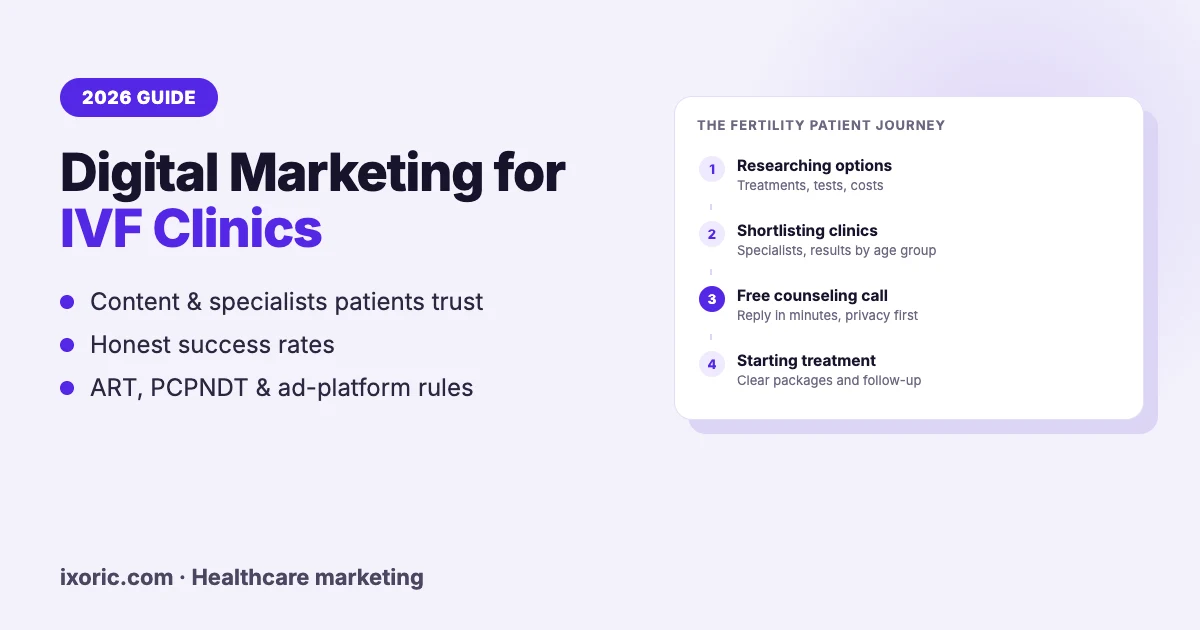
| Stage | What patients do | What wins it |
|---|---|---|
| Realizing they may need help | Search symptoms and questions: “how long to try before seeing a doctor”, “IUI vs IVF” | Clear, compassionate, clinician-reviewed explainers |
| Researching options | Read about tests, treatments, costs; watch videos; join online communities | In-depth guides, cost pages, specialist videos |
| Shortlisting clinics | Search “IVF clinic near me”, “best fertility doctor in [city]”, read reviews | Google Business Profile, named specialists, honest results, patient stories with consent |
| Consultation | Book a first appointment or a free counseling call | Easy booking, quick replies, a counselor they can talk to |
| Deciding on treatment | Compare plans and costs, often with a partner and family | Transparent packages, financing, follow-up that answers questions |
The clinics that grow are present at every stage, not just the shortlist. A couple who first read your explainer on fertility tests six months ago is far more likely to call you when they are ready.
1. Lead with your specialists
In fertility care, patients choose doctors as much as clinics. Every specialist should have a profile with qualifications (for example MD or MS in obstetrics and gynecology with fertility training, or a reproductive endocrinology fellowship), registration number, years in practice, areas of focus, languages spoken and a short video introduction. Name the embryologist and counselor too; patients increasingly ask about the lab and emotional support. Every medical page on your site should state which specialist reviewed it and when, which is what Google expects for health content.
2. Content that answers the real questions
Fertility patients research more than almost any other healthcare audience. Build a content library that answers their questions honestly:
- Treatment pages: IVF, ICSI, IUI, egg freezing, frozen embryo transfer, donor programs (where legal), fertility preservation. Each should explain who it suits, the steps and timeline, medications, risks, what affects outcomes and typical cost.
- Diagnosis pages: PCOS, endometriosis, low AMH, male factor infertility, recurrent pregnancy loss, unexplained infertility.
- Cost pages: what is included in a cycle, what is extra (medications, freezing, additional transfers), typical ranges and financing or EMI options. Hidden costs are one of the biggest causes of distrust in this category.
- Process content: what happens at the first consultation, which tests to expect, how to prepare, the two-week wait.
- Emotional support: counseling, coping with failed cycles, talking to family. Content that acknowledges how hard the journey is earns more trust than any promotional page.
Use plain language, explain medical terms the first time, and avoid promising outcomes. Pages written this way also tend to be the ones AI assistants quote when people ask fertility questions; our AEO checklist explains how to structure them.
3. Present success rates honestly
Success rates are the most searched and most misused number in fertility marketing.
- Give the basis every time: the measure (live birth per embryo transfer, per egg retrieval or per started cycle), the patient age group, own eggs or donor eggs, fresh or frozen, and the time period.
- Show results by age group, because a single clinic-wide figure hides the large effect of age.
- In the U.S., clinics report outcomes to the CDC under the Fertility Clinic Success Rate and Certification Act of 1992. SART’s advertising policy says that if a member clinic shows success data on its website, it must at minimum link to its SART clinic summary report, present supplemental data by SART age group, and state that comparing clinic success rates may not be meaningful. A 2020 study found that only 10.5% of SART member websites fully complied with the rules on supplemental data, so getting this right is a real differentiator.
- In India, present outcomes factually with their basis, and avoid “highest success rate in the city” or guaranteed-pregnancy claims; claims to cure infertility can also fall foul of the Drugs and Magic Remedies Act.
- Never imply a guarantee or use “money-back guarantee” framing without explaining exactly what it covers.
4. Google Business Profile and local SEO
Many patients shortlist clinics on Google Maps. Use the category that matches your clinic (for example “Fertility clinic” or “IVF clinic”), list every service, keep hours exact, add photos of the clinic, consultation rooms and the lab where appropriate, and make sure each location has its own profile and its own page. Ask patients for reviews with care: many fertility patients value privacy and will not want to post, so never pressure them, never offer incentives and never post on their behalf. Reply to every review without confirming that the reviewer was a patient or mentioning anything about their treatment. Our local SEO and Google Business Profile service covers this setup.
5. Advertising within the rules
| Platform or law | Key rules | What to do |
|---|---|---|
| Google Ads | Pregnancy and infertility treatments are a sensitive health category: no customer lists, no remarketing lists, no lookalike audiences | Target by location and search intent (“IVF clinic in [city]”, “IVF cost”); send each campaign to its matching page |
| Meta (Facebook and Instagram) | Health advertisers face limits on lower-funnel optimization and health-based audiences; ads must not imply knowledge of a person’s condition (“Struggling to conceive?”) | Use awareness and lead-form campaigns with neutral, supportive copy |
| PCPNDT Act (India) | Advertising sex determination or sex selection in any medium, including the internet, is a criminal offense | Never mention gender selection or “family balancing”; screen all content and landing pages |
| ART (Regulation) Act, 2021 (India) | ART clinics and banks must be registered with the national registry; advertising sex-selective ART is prohibited | Show your registration details; keep donor and surrogacy content within the Act |
| IMC code and Drugs and Magic Remedies Act (India) | No doctor self-promotion or solicitation; no claims to cure listed conditions | Promote the clinic factually; no “best IVF doctor” or guaranteed-pregnancy claims |
| HIPAA and FTC (U.S.) | Patient data on booking and intake pages is protected; testimonials and claims must be truthful and substantiated | No ad pixels on booking forms; consent and honest context for patient stories |
Search ads perform best for high-intent searches such as “IVF clinic near me”, “IVF cost in [city]” and “egg freezing cost”. Measure booked consultations, not clicks or form fills alone, and track them with neutral event names that do not reveal anything about a patient’s health. Our performance marketing team builds healthcare campaigns around these limits.
6. Nurture the long decision
Because few patients book on their first visit, follow-up is where most fertility clinics win or lose.
- Offer a low-pressure first step: a free call with a counselor or a fertility assessment consultation, not a hard sell.
- Reply fast: enquiries should get a reply within minutes during working hours, ideally from a trained counselor rather than a sales script.
- Follow up with useful information, with consent: what to expect at the first visit, test preparation, cost breakdowns, financing options, answers to common worries.
- Respect privacy: many patients have not told family or colleagues. Use discreet sender names, avoid medical detail in message previews and make it easy to stop messages.
- Stay in touch after a failed cycle, with support and next options, not pressure.
In India, most of this happens on WhatsApp. Our Vatli WhatsApp platform handles enquiries and follow-ups, and it connects to HubSpot so you can see which campaigns lead to treatment.
7. Patient stories, with care
Real stories are powerful in fertility marketing, and must be handled carefully. Get written, specific consent for each use; let patients choose anonymity; never imply that their outcome is typical; and do not feature children’s images without both parents’ agreement. In the U.S., identifiable patient stories involve protected health information and need a HIPAA authorization. In India, the Digital Personal Data Protection Rules, 2025 add consent duties for personal data, with most obligations applying from May 2027.
8. What to measure
| Metric | Why it matters |
|---|---|
| Consultations booked, by channel | The first real conversion in a long journey |
| Consultation-to-treatment rate | Shows whether leads are the right patients and whether counseling works |
| Time from first enquiry to treatment | Tells you how long to nurture and when to follow up |
| Cost per consultation and per started cycle | Ties spend to revenue |
| Enquiry response time | Slow replies lose patients to other clinics |
| Organic traffic to treatment, diagnosis and cost pages | Measures how well your content reaches people early |
Set the budget from the value of a started treatment cycle, not the consultation fee, and allow for a long attribution window: many patients convert months after their first visit.
A 90-day plan for one fertility clinic
- Weeks 1–2: complete the Google Business Profile, publish specialist profiles and a clear cost page, and display registration details.
- Weeks 3–4: set up a counselor-led enquiry process with fast replies on phone and WhatsApp, and privacy-safe tracking for consultations.
- Month 2: publish pages for your main treatments and the three most common diagnoses, each reviewed by a specialist, and launch a Search campaign for “IVF clinic” and “IVF cost” terms in your city.
- Month 3: start a consented follow-up sequence for enquiries, publish a success-rate page with its full basis, and review consultations, treatment starts and response times.
Mistakes we see most often
- A single headline success rate with no age group, measure or period.
- “Guaranteed pregnancy” or “highest success rate” claims.
- Any mention of gender selection or “family balancing” in India.
- Ads that imply the viewer has fertility problems.
- Hidden costs that surface only at the consultation.
- Sales-driven follow-up that ignores how sensitive the decision is.
- Ad pixels on consultation booking forms.
How Ixoric can help
We are a digital marketing agency, not a fertility clinic. Our healthcare work spans more than 20 clients, including hospitals and specialist clinics; for Shivansh Women’s Hospital, a maternity and laparoscopic surgery hospital in Ahmedabad, local SEO, patient-first content and Meta lead ads for maternity packages grew organic clicks 737% in four months. See our healthcare digital marketing page, our complete guide to digital marketing for clinics, or request a free audit.
FAQ: digital marketing for IVF clinics
What is the best way to market an IVF clinic?
Build trust over a long decision: named specialists with credentials, detailed and honest content on treatments, diagnoses and costs, success rates with their full basis, a strong Google Business Profile, Search ads for high-intent searches, and counselor-led follow-up that respects privacy.
Can IVF clinics advertise on Google and Facebook?
Yes, within limits. Google treats infertility and pregnancy treatments as sensitive, so ads cannot use remarketing lists, customer lists or lookalike audiences. Meta restricts health-based targeting and rejects ads that imply knowledge of a person’s condition. In India, ads must never mention sex selection.
How should IVF clinics show success rates?
Always with their basis: the measure (live birth per transfer, per retrieval or per cycle), age group, own or donor eggs, fresh or frozen and the period covered. In the U.S., SART member clinics that show success data must link to their SART clinic summary report and follow SART’s presentation rules. Never present a success rate as a guarantee.
Is it legal to advertise IVF services in India?
Yes, for registered ART clinics, provided the advertising is factual. Advertising sex determination or sex selection is a criminal offense under the PCPNDT Act, the ART (Regulation) Act prohibits advertising sex-selective ART, doctors may not solicit patients through self-promotion, and ads may not claim to cure conditions.
How long does it take for an IVF clinic to get patients from digital marketing?
Search ads and a strong Google Business Profile can bring consultations within weeks. Content and SEO usually take four to six months to build, and because patients often decide months after first contact, the full return shows over six to twelve months.
How do IVF clinics protect patient privacy in marketing?
Keep ad pixels off booking and intake pages, use neutral conversion names, use discreet sender names and message previews, get written consent for any story or photo, and never reveal in a review reply that someone is a patient.
Sources
- World Health Organization, 1 in 6 people globally affected by infertility, April 2023.
- South China Morning Post, infertility in India (ISAR estimate).
- Fertility and Sterility, SART member and non-member clinics comparison (543 ART clinics in 2021).
- SART Advertising Policy.
- Fertility and Sterility, SART advertising guidelines: how are member clinics doing? (10.5% compliance).
- CDC, National ART Surveillance System.
- India Code, Assisted Reproductive Technology (Regulation) Act, 2021.
- Stanford WILMap, Sabu Mathew George v. Union of India and The News Minute, Supreme Court tells search engines to block sex-determination ads (PCPNDT Act section 22).
- Google Ads policy, Health in personalized advertising.
- PIB, Digital Personal Data Protection Rules, 2025.
Free checklist · PDF
AEO Checklist: 10 Checks to Get Cited by AI
- Pass/fail tests for ChatGPT, Gemini and AI Overviews
- Priority and time estimate for each check
- A monthly AI citation log
Your checklist is ready.
Download the PDFWas this article helpful?
What was wrong with it?
Take this article to your AI
Get a summary, ask questions, or turn these ideas into a plan for your team.
Opens your AI with the article ready to go — for Gemini, the prompt is copied so you just paste.
Get new articles from Ixoric
Practical SEO, AI search and growth guides, about twice a month. No spam, unsubscribe any time.
You're subscribed
We'll send you new articles as they're published.
Follow us on Google
Add Ixoric as a preferred source to see our articles first in Google results.