TL;DR
The short version of this article
- Digital marketing for a dental clinic works when it matches three patient journeys: routine checkups won on Google Maps and reviews, emergencies won by phone and open hours, and high-value treatments like implants and aligners won by detailed pages, proof and follow-up.
- The highest-return work is a complete Google Business Profile, a steady flow of genuine reviews, one page per treatment, and recall reminders for existing patients, before spending on ads.
- Keep it compliant: no fake or incentivized reviews (the FTC rule has applied since 2024), no patient details in review replies, and in India only factual, non-boastful promotion under the dental code of ethics.
In this article
Digital marketing for a dental clinic is the work of making sure that the people near you who need a checkup, an emergency appointment or a treatment like implants or aligners find your practice, trust it and book. It is different from most healthcare marketing because dental demand comes in three distinct forms, each won in a different place: routine care on Google Maps, emergencies on the phone, and high-value treatments through research that can take weeks. This guide covers how to win each one, what to fix first, how to run ads and recalls, the rules that apply in the US and India, and how to measure what actually fills the chair.
A note on sources: every statistic below is linked in the list at the end. Where a figure comes from a vendor survey rather than an independent body, we say so.
Dental practices in 2026: the numbers that shape your marketing
| Metric | Figure | Source |
|---|---|---|
| Professionally active dentists in the U.S. | 205,088 (2025) | ADA Health Policy Institute |
| U.S. dentists per 100,000 people | 60.0 (2025) | ADA Health Policy Institute |
| U.S. dentists in an ADA-recognized specialty | 21.2% | ADA Health Policy Institute |
| Registered dentists in India | 376,721 (about 1 per 3,846 people) | Observer Research Foundation, November 2025 |
| Patients who check online reviews before choosing a provider | 84% | rater8 survey of 1,008 U.S. adults, December 2024 (vendor) |
What these numbers mean for a clinic:
- Most markets are crowded. With 60 dentists per 100,000 people in the U.S., and India now training far more dentists than the WHO benchmark of one per 7,500 people, most patients can choose from several practices within a short drive. You win on what they can see before they call: rating, review count, distance, hours and how clearly you explain treatments and fees.
- Google is where the comparison happens. Most patients compare practices on Google Maps before they visit any website, so your Google Business Profile is, in practice, your most-visited page.
- Specialists and general dentists need different marketing. About one in five U.S. dentists works in a specialty. An orthodontist or implant practice competes on depth of information and proof; a general practice competes on convenience and trust.
The three dental patient journeys
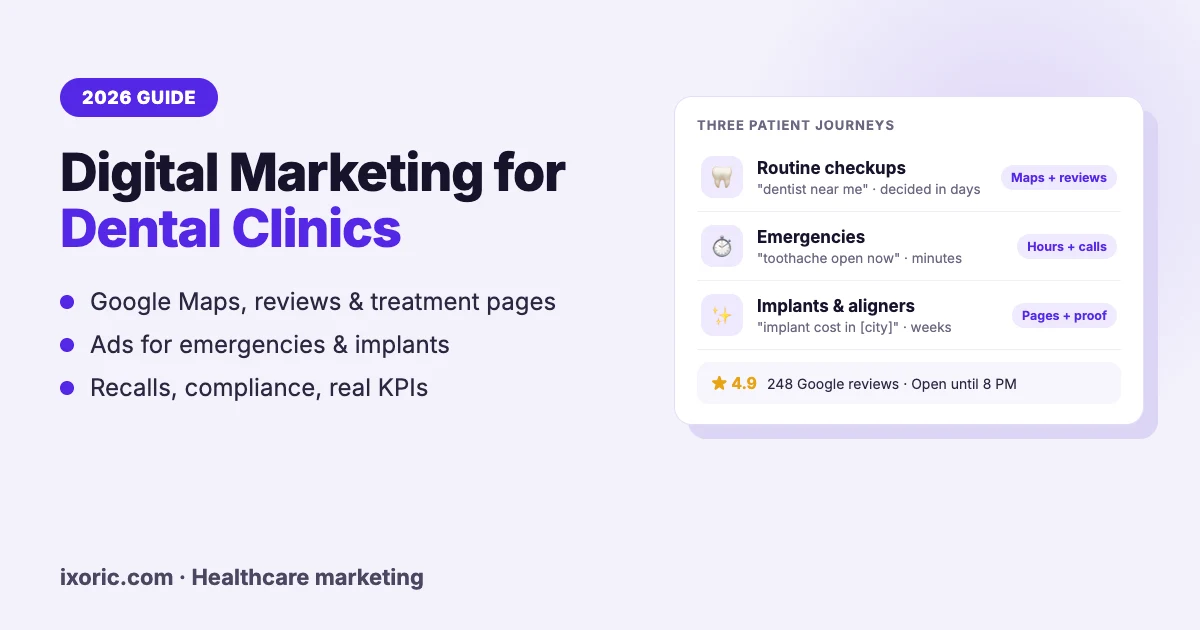
| Journey | What the patient searches | How quickly they decide | What wins |
|---|---|---|---|
| Routine care (checkups, cleaning, fillings) | “dentist near me”, “dental clinic in [area]” | Days | Map-pack visibility, rating, insurance or fees, easy online booking |
| Emergencies (toothache, broken tooth, swelling) | “emergency dentist near me”, “toothache open now” | Minutes | Open hours, a phone that is answered, same-day slots stated clearly |
| High-value treatments (implants, aligners, veneers, root canal, smile makeovers) | “dental implants cost [city]”, “Invisalign vs braces” | Weeks | Detailed treatment pages, before-and-after cases with consent, financing, clinician credentials, follow-up |
Most clinics market only the first journey. The practices that grow fastest give emergencies their own page and phone handling, and treat high-value treatments as a separate funnel with content, proof and follow-up.
1. Google Business Profile: your real front door
- Category: use “Dentist” or “Dental clinic” as the primary category and add specialties you actually provide, such as “Cosmetic dentist”, “Orthodontist”, “Dental implants periodontist” or “Emergency dental service”.
- Name: use the name on your signage. Adding keywords (“Best Dental Implant Clinic Downtown”) breaks Google’s guidelines and is a common reason profiles get suspended.
- Services and prices: list each treatment with a short description and, where you can, a starting price or price range. Patients filter on cost before they call.
- Hours: keep them exact, add special hours before every holiday, and if you take emergencies, say when.
- Photos: the building from the street, reception, treatment rooms, equipment such as the X-ray or scanner, and the team. Update them monthly.
- Booking link: point it to an online booking page or WhatsApp, with UTM tags so you can count bookings that start on Google.
- Each location gets its own profile, phone number and booking link.
Our local SEO and Google Business Profile service covers this setup in detail.
2. A website built around treatments, not just the practice
A dental website should answer the questions patients ask before they book. The pages that matter most:
- One page per treatment: implants, root canal, aligners and braces, crowns and bridges, whitening, veneers, pediatric dentistry, gum treatment, wisdom teeth. Each should explain who it is for, what happens step by step, recovery, risks, typical cost or cost factors, and financing.
- An emergency page with your emergency hours and a click-to-call button above the fold.
- Dentist profiles with qualifications, registration number, years of practice and areas of focus. Health is a topic where Google expects named, qualified authors and reviewers; each treatment page should say which dentist reviewed it and when.
- Fees and insurance: accepted insurance plans in the U.S., or starting prices in India, where patients mostly pay out of pocket. Clear pricing removes the most common reason people do not call.
- Before-and-after cases only with written patient consent, a short note on what was done, and no promise that results are typical.
- Booking: a short form or WhatsApp button on every page. Ask only for what you need to call back.
Add Dentist or MedicalClinic structured data with address, hours and services, and keep pages fast on a phone. Our website development team builds dental sites to these standards.
3. Reviews: earn them, never buy them
In rater8’s December 2024 survey, 84% of patients said they check online reviews before choosing a provider. rater8 sells review software, so treat the exact figure as directional, but every survey on the subject points the same way.
How to build a steady flow:
- Ask every patient by SMS or WhatsApp after the appointment, with a direct link to your Google review form.
- Do not filter who gets asked and do not offer discounts or gifts for reviews. Google prohibits it, and in the U.S. the FTC’s rule on fake reviews and testimonials, in force since October 2024, bans fake reviews, buying reviews and suppressing negative ones, with civil penalties per violation.
- Reply to every review, within two business days.
- Never confirm that a reviewer is a patient or mention their treatment in a reply, even if they described it. In the U.S. that is a HIPAA disclosure; HHS fined a Texas dental practice $10,000 in 2019 for exactly this. A safe reply: “Thank you for your feedback. We’d like to understand what happened; please call our practice manager at [number].”
4. Local SEO beyond the profile
- Consistent listings: the same name, address, phone and hours on Apple Maps, Bing Places, Yelp, Zocdoc or Healthgrades in the U.S., and Practo, Justdial and Lybrate in India.
- Local links: schools (dental camps and screenings), sports clubs (mouthguards), employers (corporate checkups) and local news. These are links people actually follow, which is what Google rewards.
- Area pages for the neighborhoods you serve, each with something specific to say, such as directions, parking or the patients you see from that area. Thin copies of the same page with the area name swapped do more harm than good.
5. Google Ads: emergencies and high-value treatments
Paid search pays off fastest where a patient is ready to book now or where one patient is worth a lot.
- Emergency campaigns limited to your opening hours, with call assets and a short radius. Bid on “emergency dentist”, “toothache dentist open now” and similar.
- Treatment campaigns for implants, aligners and other high-value treatments, each sending traffic to its own treatment page, not the homepage.
- Brand protection: a small campaign on your practice name, so a competitor’s ad is not the first result when someone searches for you.
- Negative keywords from day one: jobs, salary, courses, free, DIY, and treatments you do not offer.
- Track calls and bookings, not clicks. A booked consultation is the conversion that matters.
Know the targeting limits. Google treats invasive procedures and treatments for health conditions as sensitive: ads for them cannot use customer lists, your own remarketing lists or lookalike audiences, although location targeting and Google’s own predefined audiences remain available. In practice, dental advertising on Google is a search-intent and location game. Our performance marketing team builds healthcare campaigns around these rules.
6. Social media: trust and awareness
Facebook and Instagram work best for showing the people and the place: short videos introducing your dentists, a walk-through of the clinic, how a procedure works, answers to common questions, and patient stories shared with consent. Use ads for local awareness and for lead forms on high-value treatments. Meta restricts optimization and audience targeting for many health advertisers, so plan social as a trust channel rather than your main source of bookings.
7. Recalls and retention: the cheapest new revenue
The patients you already have are your highest-return audience. A practice that brings existing patients back on schedule fills the book without paying for a single click.
- Recall reminders for six-monthly checkups and cleanings by SMS, email or WhatsApp, with a one-tap booking link.
- Treatment follow-ups for patients who were given a treatment plan but did not book.
- Referral asks after a positive visit, without incentives where the rules of your market prohibit them.
In India, where most patients use WhatsApp, automated reminders and replies are usually the single biggest improvement a clinic can make. Our Vatli WhatsApp platform handles recalls and booking conversations, and it connects to HubSpot for tracking.
8. Tracking without leaking patient data
- Keep advertising pixels off booking and intake forms. In the U.S., HIPAA still covers tracking on those pages after the 2024 court ruling that narrowed HHS’s guidance for public pages.
- Record conversions as neutral events (“booking_submitted”, “call_60s”) with no treatment or condition in the name.
- In India, the Digital Personal Data Protection Rules, notified in November 2025, bring consent and security duties for patient data, with most obligations applying from May 2027. Collect only what you need and say how you will use it.
- Ask every new patient how they found you and reconcile that with your booking data monthly.
9. Be the dentist AI assistants recommend
Patients increasingly ask ChatGPT, Gemini and Google’s AI Mode questions such as “is a dental implant better than a bridge?” or “best dentist near me open on Sunday”. Those answers are assembled from Business Profile data, reviews and well-structured clinical content. Write treatment pages answer-first, show the reviewing dentist, cite clinical guidance where you make medical statements, and keep hours and services identical everywhere. Our AEO checklist walks through the steps.
10. Rules for dental clinics in India
Dental advertising in India is more restricted than in the U.S.
- Code of ethics: the Revised Dentists (Code of Ethics) Regulations, 2014 allow dentists to advertise only with decorum. Factual websites are allowed, but dentists may not publicize their own skill, boast about cases or cures, or use advertising to solicit patients.
- Regulator change: the National Dental Commission replaced the Dental Council of India on March 19, 2026, with an Ethics and Dental Registration Board handling professional conduct. Until it issues new conduct rules, follow the 2014 code and watch for updates.
- Misleading health claims: the Drugs and Magic Remedies (Objectionable Advertisements) Act, 1954 bans ads that claim to cure listed conditions, and the Supreme Court has pressed states to enforce it, including online.
In practice: keep promotion factual (services, qualifications, timings, fees, location), avoid “best dentist” claims and guarantees, run campaigns under the clinic rather than as personal promotion of a dentist, and get consent for any patient story or photo. This is general guidance, not legal advice.
11. What to measure, and how to set a budget
| Metric | Why it matters | Where to find it |
|---|---|---|
| Map-pack position for “dentist near me” and “dental clinic in [area]” | Leading indicator of new patients | A local rank-grid tool |
| Calls, direction requests and website clicks from the profile | Direct demand from Google | Google Business Profile performance |
| Booking requests and consultations booked | The conversion that pays | Booking system, WhatsApp, call tracking |
| New patients by source | Ties marketing to revenue | Practice management software plus “how did you hear” |
| Treatment acceptance rate | Shows whether leads are the right patients | Practice management software |
| Recall rate | Measures retention | Practice management software |
| Reviews per month and average rating | Drives ranking and choice | Google Business Profile |
Set the budget from what a new patient is worth to your practice. A simple illustrative calculation, with inputs you should replace with your own: if the average visit is worth $200, a patient visits twice a year and stays four years, the patient is worth about $1,600 in revenue before referrals or major treatment. If you accept spending 20% of that to acquire one, you can afford about $320 per new routine patient. High-value treatments justify a much higher cost per consultation. Start with the low-cost work (profile, reviews, treatment pages, recalls), then add ads and scale each campaign only while its cost per booked patient stays under your limit.
A 90-day plan for one clinic
- Weeks 1–2: complete the Google Business Profile (categories, services with prices, hours, photos, booking link), and set up call and booking tracking.
- Weeks 3–4: switch on automated review requests and recall reminders, and correct listings on the main directories.
- Month 2: publish an emergency page and two or three treatment pages reviewed by your dentists; launch an emergency Search campaign limited to opening hours.
- Month 3: add a treatment campaign for your highest-value service, start one local partnership (a school, club or employer), and review calls, bookings and reviews against month one.
Mistakes we see most often
- Keyword-stuffed business names that get profiles suspended.
- One generic “services” page instead of one page per treatment.
- No prices or price ranges anywhere, so patients call the clinic that shows them.
- Paying for reviews, offering discounts for reviews, or only asking happy patients.
- Review replies that confirm a patient’s treatment.
- Advertising pixels on booking forms.
- No recall system, so existing patients drift to other clinics.
How Ixoric can help
We are a digital marketing agency, not a dental practice. Our healthcare work spans more than 20 clients, including hospitals, specialist clinics and dental practices; for Shivansh Women’s Hospital, local SEO, patient-first content and Meta lead ads grew organic clicks 737% in four months. If you want a second opinion on your profile, website, ads and recalls, see our healthcare digital marketing page or request a free audit. Running an urgent care or walk-in practice instead? Read our urgent care marketing playbook, or see our complete guide to digital marketing for clinics by specialty.
FAQ: digital marketing for dental clinics
What is the best digital marketing strategy for a dental clinic?
Start with a complete Google Business Profile, a steady flow of genuine reviews and one website page per treatment, then add recall reminders for existing patients. Once those are in place, use Google Search ads for emergencies and high-value treatments such as implants and aligners, and track every campaign to booked appointments.
How much should a dental clinic spend on digital marketing?
There is no fixed percentage. Work out what a new patient is worth over a few years, decide what share of that you will spend to acquire one, and scale each channel only while its cost per booked patient stays under that limit. Profile work, reviews, treatment pages and recalls cost little and should come first.
How do I get more patients from Google Maps?
Choose the right primary and secondary categories, list every service with prices, keep hours exact, add photos monthly, ask every patient for a review and reply to all of them. Keep your name, address and phone identical across directories, and link the profile to a fast, relevant page on your website.
Is it allowed to advertise a dental clinic in India?
Yes, within limits. Factual information such as services, qualifications, timings, fees and location is acceptable, but the dental code of ethics bars dentists from publicizing their own skill, boasting about cases or soliciting patients, and ads may not claim to cure conditions. Promote the clinic, keep claims factual and avoid “best dentist” or guaranteed-result language.
Do dental Google Ads work?
They work best for emergencies and high-value treatments, where a patient is ready to book or one patient is worth a lot. Limit emergency campaigns to opening hours, send each treatment campaign to its own page, use call assets and negative keywords, and measure booked consultations rather than clicks.
Can I use before-and-after photos?
Yes, with written patient consent, an honest description of what was done and no implication that results are guaranteed or typical. In India keep them factual and avoid presenting them as proof of a dentist’s superior skill.
How long does dental SEO take?
Profile fixes can change map visibility within a few weeks. Steady ranking gains for “dentist near me” style searches usually take two to four months, and treatment pages typically need four to six months to rank well in competitive cities.
Sources
- ADA Health Policy Institute, Dentist Workforce (205,088 dentists, 60.0 per 100,000, 21.2% specialists, 2025).
- Observer Research Foundation, Dentistry in India: oversupply and gender bias, November 2025.
- rater8, How Patients Choose Their Doctors 2025 report (vendor survey of 1,008 U.S. adults, December 2024).
- Manatt, FTC issues final rule banning fake reviews and testimonials, August 2024 (rule effective October 21, 2024).
- HIPAA Journal on penalties for disclosing patient information in review replies.
- Google Ads policy, Health in personalized advertising.
- Dental Council of India, Revised Dentists (Code of Ethics) Regulations, 2014.
- PIB, Government constitutes National Dental Commission, March 2026.
- PIB, Digital Personal Data Protection Rules, 2025.
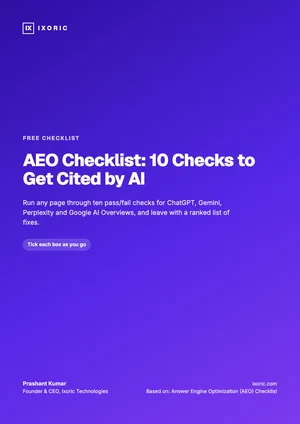
Free checklist · PDF
AEO Checklist: 10 Checks to Get Cited by AI
- Pass/fail tests for ChatGPT, Gemini and AI Overviews
- Priority and time estimate for each check
- A monthly AI citation log
Your checklist is ready.
Download the PDFWas this article helpful?
What was wrong with it?
Take this article to your AI
Get a summary, ask questions, or turn these ideas into a plan for your team.
Opens your AI with the article ready to go — for Gemini, the prompt is copied so you just paste.
Get new articles from Ixoric
Practical SEO, AI search and growth guides, about twice a month. No spam, unsubscribe any time.
You're subscribed
We'll send you new articles as they're published.
Follow us on Google
Add Ixoric as a preferred source to see our articles first in Google results.