TL;DR
The short version of this article
- Digital marketing for clinics means being found, trusted and booked by nearby patients: a complete Google Business Profile, genuine reviews, a page for every service and doctor, and easy booking come before any ad spend.
- Each specialty wins patients differently, so dental, urgent care, orthopedic, physiotherapy, wellness, aesthetic and IVF clinics each need their own channel mix, covered below.
- Healthcare advertising is regulated: no cure or guaranteed-result claims, no fake or paid reviews, no patient details in review replies, and no ad pixels on booking forms.
In this article
Digital marketing for clinics is the work of making sure that when someone near you needs the care you provide, they find your clinic, trust it and book. For most clinics that comes down to a handful of things done well: a complete Google Business Profile, a steady flow of genuine reviews, a website with a page for every service and doctor, easy booking by phone, form or WhatsApp, and follow-up that brings patients back. Ads, social media and content build on that foundation; they do not replace it.
This guide covers the foundations every clinic needs, the channels in order of return, how marketing differs by specialty, the rules that apply in the US and India, and how to choose a healthcare marketing agency if you would rather not do it yourself. Statistics are linked to their sources at the end; vendor surveys are labelled as such.
Why clinics need a deliberate online presence
Patients now choose a clinic before they ever call it. Google has reported that about 7% of its daily searches are health-related, and in rater8’s December 2024 survey of 1,008 U.S. adults, 84% said they check online reviews before choosing a provider (rater8 sells review software, so treat the figure as directional). The comparison happens on one screen: who appears for the service and area searched, their rating and how recent their reviews are, whether the doctor’s credentials and timings are clear, and how easy it is to book.
Health is also a “Your Money or Your Life” topic. Google’s search quality guidelines hold medical pages to their highest bar for experience, expertise, authoritativeness and trust, so clinics need named, qualified authors or reviewers, accurate information and visible signs that a real, accountable practice stands behind the website.
The online presence every clinic needs
A clinic’s online presence is everything a patient can see about it before visiting: the Google Business Profile, website, reviews, directory listings, social profiles and how quickly messages are answered. This checklist covers the essentials, in order.
| Element | What good looks like | Why it matters |
|---|---|---|
| Google Business Profile | Correct primary category, every service listed, exact hours, 20+ real photos, booking link | Decides whether you appear on Google Maps and in local results |
| Reviews | New Google reviews every week, every review answered | Rating and recency drive both ranking and choice |
| Website | A page per service and per doctor, fees or price ranges, fast on a phone | Answers the questions that stop patients calling |
| Doctor profiles | Qualifications, registration number, experience, areas of focus, photo | Trust, and Google’s E-E-A-T expectations for health content |
| Booking | Click-to-call, a short form and WhatsApp on every page | Every extra step loses patients |
| Directory listings | Same name, address, phone and hours on Practo, Justdial, Apple Maps, Bing, Healthgrades, Zocdoc | Consistency supports map rankings and avoids wasted trips |
| Follow-up | Reminders, recalls and review requests by SMS or WhatsApp | The cheapest way to fill appointments |
If a clinic does only these seven things well, it will usually outperform competitors who spend heavily on ads but neglect them.
The core channels, in order of return
1. Google Business Profile and local SEO
For any clinic that sees patients in person, the Google Maps “3-pack” produces more calls and visits than any other channel. Choose the primary category that matches what you do (for example “Dentist”, “Physiotherapist”, “Orthopedic surgeon” or “Medical clinic”), add secondary categories only for services you provide, list each service with a description, keep hours exact including holidays, and post updates and new photos monthly. Use the name on your signage; adding keywords to the business name breaks Google’s guidelines and gets profiles suspended. Each location needs its own profile and its own page on your website. Our local SEO and Google Business Profile service covers the full setup.
2. Reviews and reputation
Ask every patient for a review after the visit with a direct link, by SMS or WhatsApp. Do not ask only happy patients, do not offer discounts or gifts in return, and never post fake reviews: Google prohibits all three, and in the U.S. the FTC’s rule on fake reviews and testimonials has applied since October 21, 2024. Reply to every review, but never confirm that the reviewer is a patient or mention their treatment. A safe reply is: “Thank you for your feedback. We’d like to understand what happened; please call our clinic manager on [number].”
3. A website built for patients
Each service and condition you treat deserves its own page that explains who it is for, what happens, recovery, risks, typical cost or cost factors and how to book. Add a page for each doctor, an FAQ that answers what patients actually ask, and visible fees or price ranges where your market allows. Every medical page should name the clinician who reviewed it and the date. Add MedicalClinic or Physician structured data and keep pages fast on a phone. Our website development team builds clinic sites to this standard.
4. Search ads for ready-to-book patients
Google Search ads work when a patient is ready to book now or when one patient is worth a lot: emergencies, specific procedures and high-value treatments. Limit campaigns to the area you serve and your opening hours, send each campaign to its matching service page, use call assets, add negative keywords for jobs, courses and services you do not offer, and measure booked appointments rather than clicks. Google treats many health conditions and invasive procedures as sensitive, so those ads cannot use customer lists, remarketing lists or lookalike audiences; location and search-intent targeting remain available. Our performance marketing team builds campaigns around these limits.
5. Social media for trust
Instagram, Facebook and YouTube are best for showing the people and the place: doctor introductions, a walk-through of the clinic, explainers of common procedures and patient stories shared with written consent. Meta restricts lower-funnel optimization and health-related audiences for many health advertisers, so treat social as a trust and awareness channel rather than your main source of bookings.
6. WhatsApp and follow-up
In India most clinic enquiries end up on WhatsApp. Fast replies, appointment reminders, recalls and post-visit review requests convert more of the demand you already have, at almost no cost. Our Vatli WhatsApp platform is built for this and connects to HubSpot so every enquiry is tracked.
7. Content and AI search
Patients increasingly ask ChatGPT, Gemini and Google’s AI Overviews health questions before choosing a clinic. Answer-first service pages, clinician-reviewed explainers and consistent business details make it more likely those answers mention you. Our AEO checklist walks through the steps.
Digital marketing by clinic type
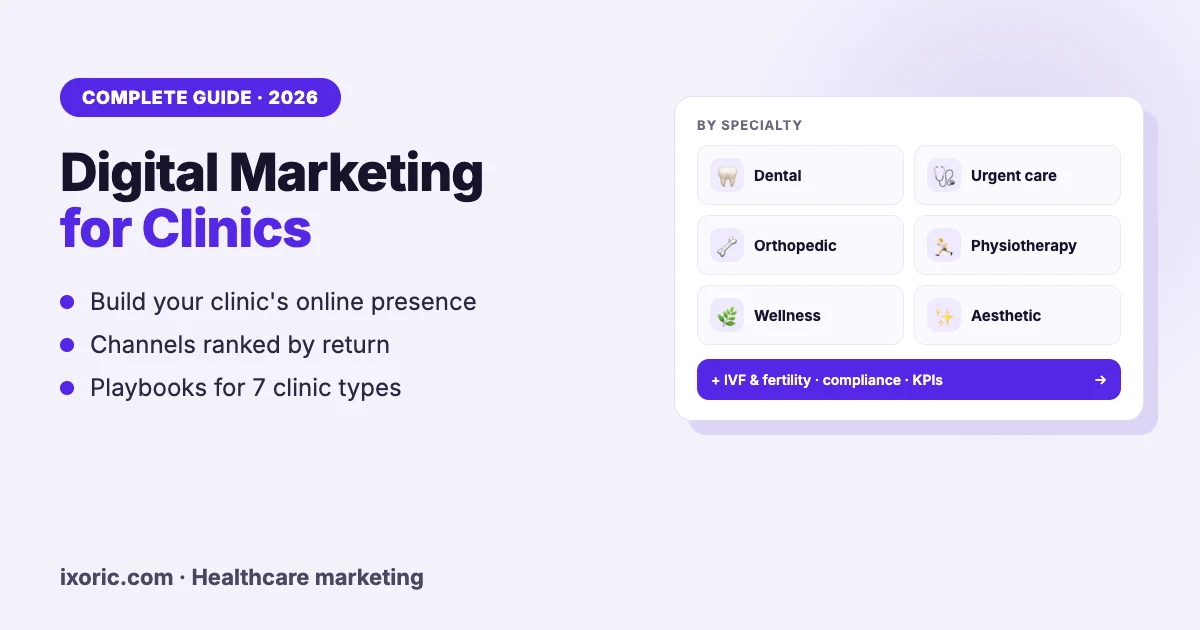
Every specialty shares the foundations above, but each wins patients in a different way.
| Clinic type | How patients search | Channel priorities | Watch out for |
|---|---|---|---|
| Dental | “dentist near me”, “implant cost in [city]” | Maps and reviews, one page per treatment, emergency ads, recalls | Before-and-after photos need consent; India’s dental code limits self-promotion |
| Urgent care and walk-in | “urgent care open now” | Maps with exact hours, online check-in, ads limited to opening hours | Ad pixels on check-in forms |
| Orthopedic | “knee specialist near me”, “ACL surgery cost” | Condition and procedure pages, surgeon profiles, referral relationships | Outcome claims for surgery |
| Physiotherapy | “physiotherapist near me”, “back pain physio” | Maps, condition pages, packages, home visits, referral partners | Recovery claims, insurer or referral rules |
| Wellness | “IV therapy near me”, “weight loss clinic” | Clear service pages, transparent pricing, social proof | Unsupported health claims |
| Aesthetic | “botox cost in [city]”, “laser hair removal” | Before-and-after galleries with consent, pricing, Instagram | Google treats cosmetic procedures as sensitive |
| IVF and fertility | “IVF cost”, “IVF success rate” | In-depth guides, counselor access, follow-up over weeks | Success-rate claims and sensitive targeting |
Dental clinics
Dental demand comes in three forms: routine checkups won on Google Maps and reviews, emergencies won by phone and open hours, and high-value treatments like implants and aligners won by detailed pages, proof and follow-up. Recalls for existing patients are usually the cheapest source of appointments. Read the full playbook: digital marketing for dental clinics.
Urgent care and walk-in clinics
Patients decide in minutes, mostly on the map: who is open, close, well rated and quick. Exact hours, online check-in, a live wait time and Search ads that run only while you are open matter most. Read the full playbook: digital marketing for urgent care centers and clinics.
Orthopedic clinics
Orthopedic patients research longer, often for weeks before a joint replacement or sports surgery, and many arrive by referral. Build a page for each condition and procedure (knee pain, ACL reconstruction, hip replacement, spine), each reviewed by the surgeon and covering when surgery is and is not needed, recovery timelines and costs. Detailed surgeon profiles carry more weight here than in most specialties. Run Search ads on procedure and condition terms rather than broad ones, and nurture enquiries with follow-up, because the decision is rarely made on the first visit. Build relationships with physiotherapists, sports clubs and general practitioners who refer patients. Describe outcomes carefully, with no guarantees.
Physiotherapy clinics
Physiotherapy is often a repeat-visit, package-based service, so retention matters as much as acquisition. In the U.S., the American Physical Therapy Association reports that since July 2025 patients in all 50 states have at least provisional direct access to physical therapists without a physician referral, although limits and payer rules vary by state; marketing directly to patients is therefore worthwhile, alongside referral partners. In India, physiotherapy is now regulated under the National Commission for Allied and Healthcare Professions Act, 2021. Priorities: map visibility for “physiotherapist near me”, a page per condition (back pain, frozen shoulder, sports injuries, post-surgery rehab), clear session and package pricing, home-visit options, and reminders that keep patients on their plan.
Wellness clinics
Wellness clinics, such as IV therapy, weight management, hormone and longevity services, need the most care with claims. In the U.S., the FTC’s Health Products Compliance Guidance (December 2022) expects health claims to be backed by competent and reliable scientific evidence, usually well-designed human trials, and testimonials cannot be used to make claims you could not make directly. In India, the Drugs and Magic Remedies (Objectionable Advertisements) Act bans ads claiming to cure listed conditions. Market what you can stand behind: the service, who delivers it, their qualifications, what to expect, price and safety. Transparent pricing and genuine reviews usually do more than bold promises.
Aesthetic clinics
Aesthetic patients compare prices, results and the practitioner’s credentials. Before-and-after galleries need written consent and honest context, and pricing pages convert well. Google treats cosmetic and invasive procedures as sensitive, so ads cannot use remarketing or customer lists; Instagram and search-intent ads carry most of the weight. Read the full playbook: digital marketing for aesthetic clinics.
IVF and fertility clinics
Fertility decisions are emotional, expensive and slow, often taking months. Patients need clear explanations of the process, costs and what affects outcomes, access to a counselor, and steady follow-up. Present success rates only with the basis for them (age group, cycle type, period) and never as a guarantee; targeting is limited because fertility is a sensitive category on both Google and Meta. Read the full playbook: digital marketing for IVF clinics.
The rules clinics have to follow
| Rule | Applies to | What it means for marketing |
|---|---|---|
| IMC (Professional Conduct, Etiquette and Ethics) Regulations, 2002 | Doctors in India | No soliciting patients through self-promotion; NMC’s 2023 conduct regulations are in abeyance, so the 2002 code applies |
| Dentists (Code of Ethics) Regulations, 2014 | Dentists in India | Factual websites allowed; no publicizing one’s own skill or boasting about cases; the National Dental Commission replaced the DCI in March 2026 |
| Drugs and Magic Remedies Act, 1954 | All health advertisers in India | No claims to cure listed diseases and conditions, including online |
| DPDP Act, 2023 and Rules, 2025 | Patient data collected in India | Consent and security duties, most applying from May 2027 |
| HIPAA | U.S. clinics and their vendors | No ad pixels on booking, intake or portal pages; no patient details in review replies |
| FTC fake-review rule and Health Products Compliance Guidance | U.S. clinics | No fake, paid or suppressed reviews; health claims need scientific substantiation |
| Google and Meta health ad policies | Everywhere | Some services need certification; no remarketing or customer lists for sensitive health topics |
This is general guidance, not legal advice. Check current notifications for your specialty and country before launching campaigns.
What to measure
Measure what fills the appointment book: calls and WhatsApp enquiries, booking requests and booked appointments, cost per booked appointment by channel, no-show rate, review count and rating per location, map visibility for your main services, and the share of patients who return or complete their plan. Impressions, likes and clicks matter only when they move one of these. Record conversions as neutral events with no condition or treatment in the name, and ask every new patient how they found you.
For budget, work out what a new patient is worth to your clinic over a year or two, decide what share of that you will spend to acquire one, and scale each channel only while its cost per booked patient stays under that limit. Profile work, reviews, service pages and follow-up cost little and should come before ads.
How to choose a digital marketing agency for healthcare clinics
If you hire help, a digital marketing agency for healthcare clinics should be able to answer these questions clearly:
- Can you show a named healthcare result? Look for a case study with the clinic named and figures from its own Search Console, Analytics or Ads account.
- Who will run my account, and what are their credentials? You should meet that person before signing.
- How do you handle medical advertising rules? Ask how they deal with claims, doctor promotion, before-and-after content and health ad policies in your market.
- How do you track bookings without exposing patient data? The answer should mention keeping ad pixels off booking forms and using neutral conversion events.
- Will I own all accounts and data? Google Business Profile, Ads, Analytics and Search Console should be in your name.
- How do you get reviews? Any mention of buying, incentivizing or filtering reviews is a reason to walk away.
- What will you report, and how often? Weekly or monthly reports should show calls, bookings and cost per booking, not just traffic.
Red flags: guaranteed rankings, “100% success” language in ads, ad accounts set up in the agency’s name, and reports made of impressions and likes.
How Ixoric helps clinics
We are a digital marketing agency, not a clinic. Our healthcare work spans more than 20 clients, including hospitals, specialist clinics, diagnostic labs and dental practices. For Shivansh Women’s Hospital in Ahmedabad, local SEO, patient-first content and Meta lead ads grew organic clicks 737% in four months, and for Talkthru.me, a U.S. mental-health app, we ran Google Ads at $0.88 per conversion. See our healthcare digital marketing page for services and pricing, or request a free clinic audit.
FAQ: digital marketing for clinics
What is digital marketing for clinics?
Digital marketing for clinics is the use of Google Maps, search, reviews, websites, ads, social media and messaging to help nearby patients find, trust and book a clinic. For most clinics the foundation is a complete Google Business Profile, genuine reviews, a page per service and doctor, and easy booking.
How can I improve my clinic’s online presence?
Start with the Google Business Profile: correct categories, every service, exact hours, real photos and a booking link. Then ask every patient for a review, build a page for each service and doctor, keep your details identical across directories, and reply quickly to calls and WhatsApp messages.
Which digital marketing channel is best for a small clinic?
For a single-location clinic, Google Business Profile and reviews usually bring the most patients for the least money, followed by a well-built website and WhatsApp follow-up. Add Google Search ads once those are in place, starting with the services patients book urgently or that are worth the most.
How much should a clinic spend on digital marketing?
There is no fixed percentage. Estimate what a new patient is worth to your clinic, decide what share of that you will spend to acquire one, and scale each channel only while its cost per booked appointment stays under that limit. Ixoric’s healthcare plans start at ₹25,000 a month for local SEO and Google Maps, plus ad spend paid directly to Google or Meta.
Can clinics run Google Ads?
Yes, with limits. Google restricts some health services and does not allow remarketing or customer lists for ads about sensitive health conditions or invasive procedures. In India, ads must also avoid claims to cure conditions and should promote the clinic rather than an individual doctor’s skill.
How long does it take for a clinic to rank on Google Maps?
Profile fixes can change visibility within weeks. Map-pack rankings usually move in one to two months in smaller cities and two to four months in competitive metros, depending on distance, reviews and how complete competitors’ profiles are.
Should I hire a healthcare marketing agency or do it myself?
A clinic owner can handle the profile, reviews and WhatsApp follow-up with a few hours a week. An agency makes sense when you need a website rebuilt, ads managed, content written and reviewed, or several locations handled together; choose one that can show named healthcare results and explain how it handles medical advertising rules.
Sources
- Becker’s Hospital Review, Google health-search estimate (via The Telegraph).
- rater8, How Patients Choose Their Doctors 2025 report (vendor survey, December 2024).
- American Physical Therapy Association, State of Direct Access to Physical Therapist Services, 2025.
- Covington, FTC issues new guidance on health-related claims (Health Products Compliance Guidance, December 2022).
- Manatt, FTC issues final rule banning fake reviews and testimonials (effective October 21, 2024).
- Medical Dialogues, NMC places 2023 conduct regulations in abeyance.
- Dental Council of India, Revised Dentists (Code of Ethics) Regulations, 2014.
- LiveLaw, Supreme Court on enforcing the Drugs and Magic Remedies Act.
- PIB, Digital Personal Data Protection Rules, 2025.
- Google Ads policy, Health in personalized advertising.
- Medical Dialogues, NCAHP revised physiotherapy curriculum.
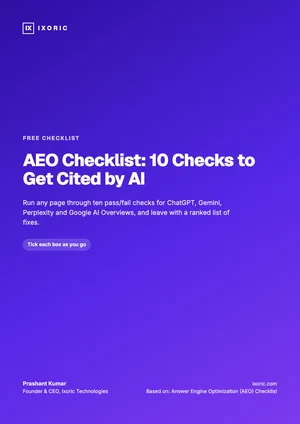
Free checklist · PDF
AEO Checklist: 10 Checks to Get Cited by AI
- Pass/fail tests for ChatGPT, Gemini and AI Overviews
- Priority and time estimate for each check
- A monthly AI citation log
Your checklist is ready.
Download the PDFWas this article helpful?
What was wrong with it?
Take this article to your AI
Get a summary, ask questions, or turn these ideas into a plan for your team.
Opens your AI with the article ready to go — for Gemini, the prompt is copied so you just paste.
Get new articles from Ixoric
Practical SEO, AI search and growth guides, about twice a month. No spam, unsubscribe any time.
You're subscribed
We'll send you new articles as they're published.
Follow us on Google
Add Ixoric as a preferred source to see our articles first in Google results.