Key Takeaways
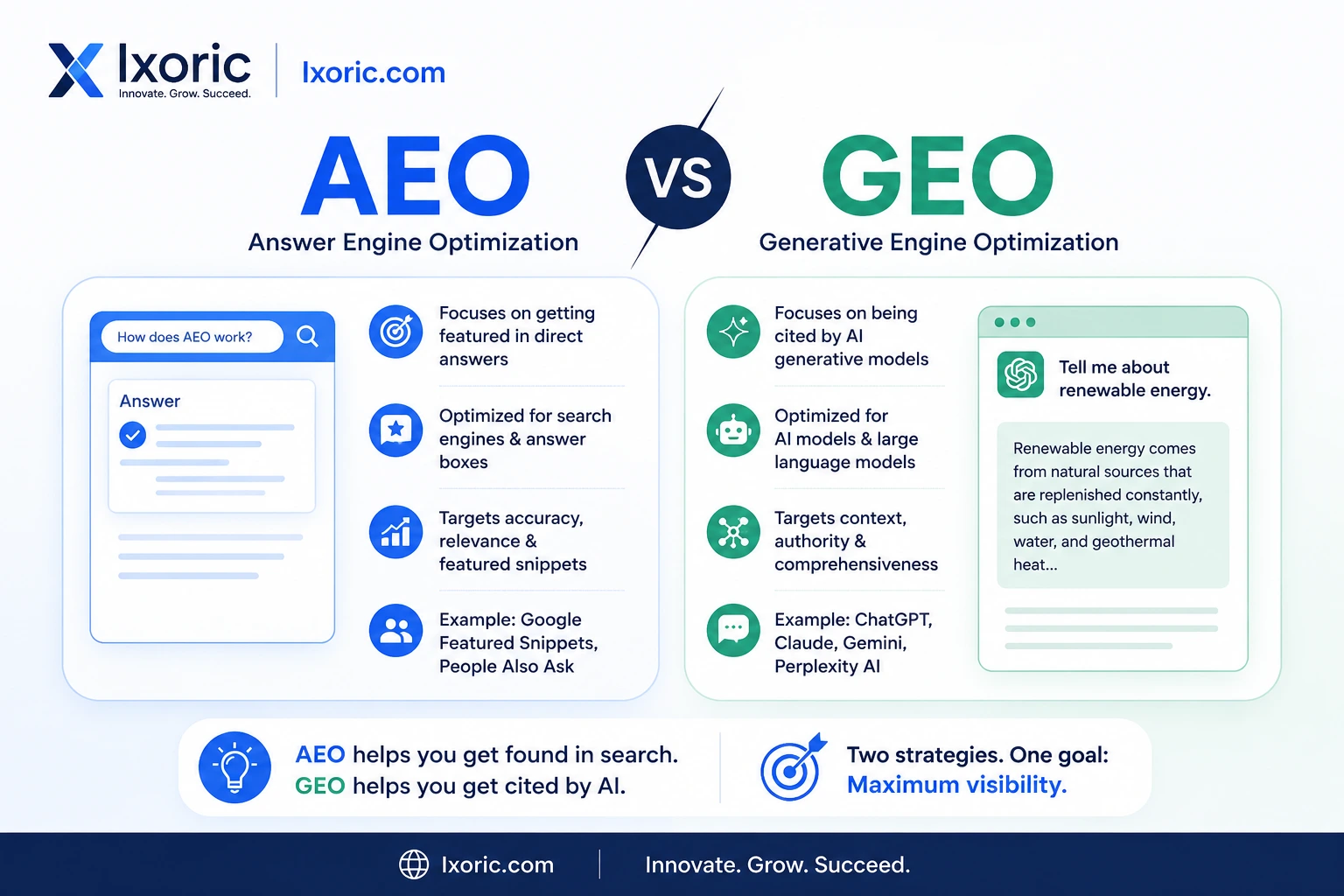
- AEO optimizes for being extracted as a direct answer; GEO optimizes for being cited within a synthesized, generative response.
- AEO favours short, precise, question-first content. GEO favours depth, original data, and demonstrated expertise.
- The two aren’t in competition — the best content strategies build for both at once.
- Technical fundamentals (structure, schema, credibility signals, freshness) support both disciplines equally.
AEO vs GEO. If you’ve been researching how to make your content visible in AI search, you’ve probably run into two acronyms within the same breath: AEO (Answer Engine Optimization) and GEO (Generative Engine Optimization). Marketers often use them interchangeably — and in practice, they overlap heavily. But they aren’t quite the same discipline, and understanding the distinction helps you know what to prioritize as you build out your content strategy.
The short version: AEO is about being chosen as the direct answer. GEO is about being represented well inside a generated response, even when it’s part of a longer, synthesized narrative. The difference is subtle, but it changes how you write.
What Is GEO (Generative Engine Optimization)?
Generative Engine Optimization refers to optimizing content so it gets surfaced, cited, or paraphrased by generative AI systems — tools like ChatGPT, Gemini, Claude, and Perplexity that don’t just extract a single answer but synthesize information from multiple sources into a new, original response.
Where a traditional search result or featured snippet pulls a single passage verbatim, a generative engine often blends several sources, restates them in its own words, and may cite two or three of them as supporting references. GEO is concerned with earning a place among those references — being one of the sources the model draws from and trusts enough to credit.
What Is AEO (Answer Engine Optimization)?
Answer Engine Optimization, covered in more depth in our main guide to AEO, focuses on structuring content so it can be lifted directly as the answer to a specific question—typically in an extractive context like Google’s AI Overviews, a featured snippet, or a voice assistant’s spoken reply.
AEO content tends to be built around a single, clearly answerable question, with the answer positioned at the very top so it can be extracted with minimal interpretation.
AEO vs GEO: Where They Actually Diverge
| AEO | GEO | |
| Primary environment | Featured snippets, AI Overviews, voice assistants | Conversational AI (ChatGPT, Perplexity, Gemini, Claude) |
| Content is used as | The direct, extracted answer | One of several sources synthesized into a new answer |
| Ideal content shape | Short, self-contained, one question per section | Comprehensive, well-cited, authoritative on the broader topic |
| What “success” looks like | Your exact sentence appears as the answer | Your brand or data point is referenced within a blended response |
| Writing style | Direct, extractive, answer-first | Explanatory, well-supported, original insight and data-driven |
In practice, an answer engine tends to reward precision — one clean, quotable answer. A generative engine tends to reward depth and credibility — original research, clear expertise signals, and content substantial enough to be worth citing as a source rather than just extracting a line from.
Why the Distinction Matters for Your Content Strategy
If you optimize only for AEO, you might produce short, snippet-friendly answers that are excellent for voice search and featured snippets but too thin to be cited by a generative model performing deeper synthesis.
If you only optimize for GEO, you might produce long-form, well-researched pieces that generative engines happily cite — but that never win a featured snippet or AI Overview placement because the answer isn’t front-loaded or extractable on its own.
The strongest content strategy treats these as complementary layers rather than competing approaches:
- Structure each page with a direct, extractable answer near the top (serves AEO)
- Follow it with original data, examples, or expertise-driven depth (serves GEO)
- Support both with clean technical structure — headings that mirror real questions, and schema markup that clarifies what the page is about
Do You Need to Choose Between Them?
No — and trying to pick one over the other usually means leaving visibility on the table in the other channel. A single well-built page can realistically:
- Win a featured snippet or AI Overview citation for a specific, narrow question (AEO)
- Get referenced as a source when a generative AI tool answers a broader, related question (GEO)
The overlap is large enough that most practical checklists — clear structure, factual accuracy, credible authorship, and up-to-date information — apply to both. The difference is mainly a matter of emphasis: precision for AEO, depth and citability for GEO.
A Simple Way to Think About It
If AEO is about answering “What is X?” in one clean sentence, GEO is about being the source an AI model reaches for when someone asks a harder question that touches your topic — even if they never phrase it the way your page is titled.
Write for the direct question, but don’t stop there. The businesses earning consistent AI visibility in 2026 are the ones building genuine topical depth, not just chasing individual snippet wins.
What about “AEO” and “GEO”? “AEO” stands for “answer engine optimization” and “GEO” for “generative engine optimization”. These are both terms you may see used to describe work specifically focused on improving visibility in AI search experiences. From Google Search’s perspective, optimizing for generative AI search is optimizing for the search experience, and thus still SEO.
Find one of the best optimization teams for your website and business at Ixoric Technologies.