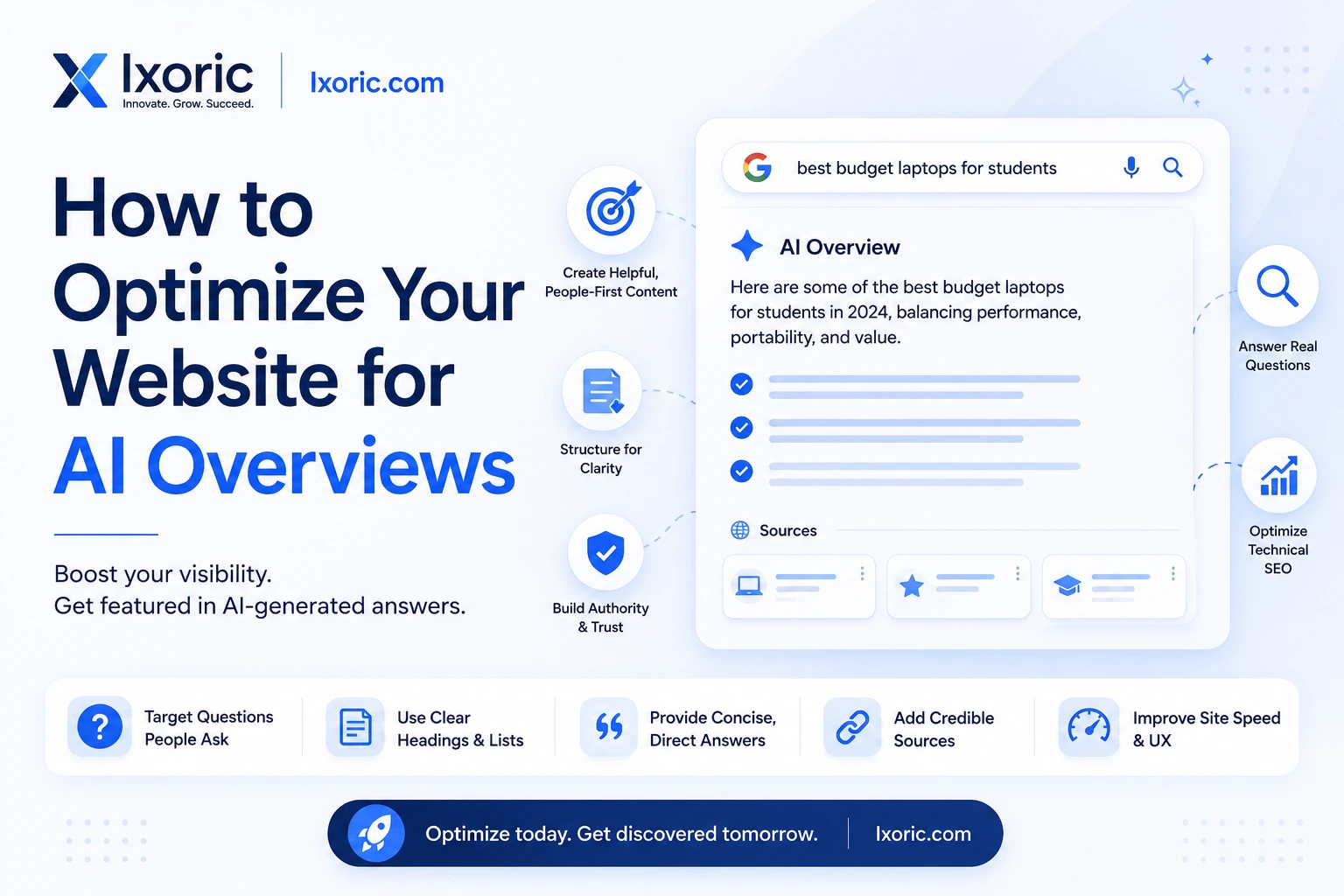
Key Takeaways – how to optimize for AI Overviews :
- Optimizing for AI Overviews is largely an extension of solid SEO, with much heavier emphasis on structure and extractability.
- Answer questions in the first two sentences of every section, and make sections independently understandable.
- Schema markup and credibility signals — real authors, real dates, real citations — determine whether AI systems trust your page enough to name it.
- Off-page reputation and third-party mentions often decide which of several eligible pages gets cited.
- Depth beats formatting; formatting beats obscurity. You need both.
- Measure with direct prompt testing, and treat citation-tracking tools as directional.
How to Optimize for AI Overviews and ChatGPT Answers. There’s a growing gap between ranking well and being seen. A page can sit comfortably at position three in Google and still be invisible to a user who reads the AI Overview at the top and never scrolls. The same page might never be mentioned when someone asks ChatGPT the exact question it was written to answer.
This guide walks through what actually influences whether AI systems find, trust, and cite your content — and the practical steps to implement on your own website. It’s organized as a sequence, from foundations to measurement, so you can work through it in order.
One clarification before starting, because it saves a lot of wasted effort: in May 2026, Google published its first official guidance on optimizing for generative AI features, and its position was that because AI Overviews and AI Mode are built on core Search ranking systems, optimizing for them is still fundamentally SEO. There is no separate secret algorithm. What changes is emphasis — clarity, structure, and extractability matter far more than they used to.
Step 1: Fix the Technical Foundation First
If an AI system can’t crawl and render your page, nothing else in this guide matters.
Confirm AI crawlers can access your site
Different AI platforms use different bots, and many sites block them accidentally through overly aggressive robots.txt rules or firewall settings. The main ones to check for:
| Crawler | Platform | Purpose |
| Googlebot | Google AI Overviews / AI Mode | Standard indexing (also feeds AI features) |
| GPTBot | OpenAI | Training and indexing |
| OAI-SearchBot | ChatGPT Search | Live search retrieval |
| ClaudeBot | Anthropic | Crawling for Claude |
| PerplexityBot | Perplexity | Search index |
| Bingbot | Bing / Copilot | Indexing (feeds several AI tools) |
Open your robots.txt and verify none of these are disallowed unintentionally. Then check your server logs or CDN dashboard to confirm these bots are actually reaching your pages rather than being challenged by bot protection.
A note on blocking: you may have legitimate reasons to block training crawlers while allowing retrieval crawlers. If so, block GPTBot but keep OAI-SearchBot open — blocking both removes you from ChatGPT’s search results entirely.
Make sure content renders without JavaScript
Many AI crawlers have weaker JavaScript rendering than Googlebot. If your key content only appears after client-side JS execution, it may simply not exist as far as some AI systems are concerned. Test by disabling JavaScript in your browser and reloading a key page. If the main content disappears, that’s a priority fix — server-side rendering or static generation for content pages.
Core Web Vitals still matter
Slow pages get crawled less thoroughly and less often. This isn’t AI-specific, but it compounds: fewer crawls means slower discovery of updates, and freshness is a factor in whether AI systems cite you.
A realistic note on llms.txt
You’ll see a lot of advice recommending an llms.txt file at your site root — a clean Markdown summary of your site intended for AI models. It’s worth understanding the actual state of adoption before spending time on it:
- Google has publicly stated it does not support llms.txt and has no plans to, meaning it does not affect AI Overviews or AI Mode.
- Measured crawler interest from the major answer engines has been very low in practice.
That doesn’t make it harmful — it’s a small file and costs little to add. But it should be a low-priority item, not a centerpiece of your strategy. Prioritize the fundamentals in this guide first.
Step 2: Research the Questions, Not Just the Keywords
AI search is question-driven. Your research process needs to reflect that.
Sources for real questions
- “People Also Ask” boxes — search your core topics in an incognito window and document every PAA question that appears. Expand a few and note the follow-ups that populate.
- Your own sales and support conversations — the questions prospects actually ask before buying are often the highest-value AEO targets and rarely appear in keyword tools.
- Community platforms — Reddit, Quora, and industry forums show you how people phrase problems in their own words, which is much closer to how they prompt an AI.
- Direct prompt testing — ask ChatGPT, Perplexity, and Gemini your target questions yourself. Note which sources get cited and what those pages have in common.
Map questions to buying stages
Not every question is worth targeting. Sort them:
- Awareness — “What is X?” Broad, high-volume, good for authority building, low direct conversion.
- Consideration — “X vs Y,” “best X for [use case],” “how much does X cost.” These are where AI citations translate into real business impact, because the user is comparing options.
- Decision — “how to choose an X provider,” “what to ask an X agency.” Lower volume, very high intent.
If you have limited resources, start in the consideration layer. That’s where being named inside an AI answer directly influences a purchase decision.
Think in prompts, not search volume
Traditional keyword volume tools measure typed searches. They don’t capture how often people ask an AI a given question — a metric some tools now approximate as “prompt volume.” Until that data matures, treat keyword volume as directional only, and weight your own qualitative evidence (sales calls, support tickets) more heavily than you would in a classic SEO plan.
Step 3: Structure Content So It Can Be Extracted
This is where most sites lose. The content may be good, but it isn’t liftable.
Use the inverted pyramid, ruthlessly
Answer the question in the first one or two sentences of the section. Then add context, nuance, examples, and caveats below it.
Weak structure:
Over the past several years, the digital marketing landscape has undergone dramatic transformation. Businesses everywhere are grappling with change. In this article, we’ll explore one of the most important developments…
Nothing extractable. An AI system reading this has no self-contained answer to pull.
Strong structure:
Answer Engine Optimization is the practice of structuring content so AI systems can extract it and present it as a direct answer to a user’s question. It differs from traditional SEO in that the goal is being cited inside the answer rather than ranking as a link beside it.
Two sentences, self-contained, quotable without needing surrounding context.
Make every section independently understandable
AI systems process content in chunks. A section that relies on the previous three paragraphs for meaning is hard to extract cleanly. Practical rules:
- Avoid opening sections with “this,” “it,” or “as mentioned above” referring to earlier content
- Restate the subject rather than using a pronoun when starting a new section
- Keep each H2, or H3 focused on a single answerable question
Write headings that mirror real questions
Instead of clever headings, use the phrasing your audience actually uses.
- Weak: “The New Search Reality”
- Strong: “How Do AI Overviews Choose Which Sources to Cite?”
Question-form headings do two things: they signal to crawlers exactly what the section answers, and they align with the conversational phrasing of AI prompts.
Front-load specifics
Vague statements are rarely cited. Specific, verifiable ones are. Compare:
- Weak: “Many businesses are seeing significant traffic changes from AI search.”
- Strong: “Research from GEO firm Brandlight found the overlap between top Google links and AI-cited sources fell from around 70% to under 20%.”
The second is citable because it contains a concrete, attributable claim. Wherever you have real numbers — your own client data especially — put them in and attribute them clearly.
Format for machine parsing
- Use proper heading hierarchy (one H1, logical H2/H3 nesting) — not styled <div> text that looks like a heading
- Use tables for comparisons; AI systems parse them well
- Use numbered lists for sequential processes and bulleted lists for non-sequential sets
- Keep paragraphs to 2–4 sentences; dense blocks are harder to chunk cleanly
- Include a summary or key takeaways block near the top or bottom of long pages
Step 4: Implement Structured Data
Schema markup doesn’t guarantee a citation, but it removes ambiguity about what your page contains, who wrote it, and when it was updated. AI systems parse JSON-LD to confirm entities, authorship, and dates before trusting a page enough to name it as a source.
Priority schema types
Article / BlogPosting — for every blog post. Include author (with a real, linked person entity), datePublished, dateModified, and publisher.
FAQPage — for pages with genuine question-and-answer sections. Don’t fabricate questions to game this; use it where the Q&A format is real.
HowTo — for step-by-step guides, with each step marked up individually.
Organization — on your homepage or about page, establishing your business entity, including sameAs links to your social and directory profiles. This helps AI systems connect mentions of your brand across the web to a single entity.
Person — for author profiles, linked from your Article schema. This is a direct expertise signal.
Breadcrumb — helps establish site structure and topical relationships.
A basic Article schema example
json
{
“@context”: “https://schema.org”,
“@type”: “BlogPosting”,
“headline”: “How to Optimize Your Website for AI Overviews and ChatGPT Answers”,
“datePublished”: “2026-07-30”,
“dateModified”: “2026-07-30”,
“author”: {
“@type”: “Person”,
“name”: “Author Name”,
“url”: “https://yoursite.com/about/author-name”,
“jobTitle”: “Head of SEO”
},
“publisher”: {
“@type”: “Organization”,
“name”: “Your Company”,
“logo”: {
“@type”: “ImageObject”,
“url”: “https://yoursite.com/logo.png”
}
}
}
Validate everything with Google’s Rich Results Test before publishing. Broken schema is worse than no schema — it signals sloppiness on a page where you’re asking to be trusted.
Step 5: Build the Credibility Signals AI Systems Look For
AI systems weigh E-E-A-T signals — experience, expertise, authoritativeness, trustworthiness — when deciding which sources to reference. These aren’t abstract; they’re concrete things you can add to a page.
On-page credibility
- Named authors with real bios, including relevant credentials and a link to a full author page. Anonymous or “Admin”-authored content is a meaningful disadvantage.
- Visible publication and update dates. Freshness influences citation likelihood, and a page with no date is harder to evaluate.
- Outbound citations to primary sources. Linking to original research, official documentation, or government data signals that your claims are grounded. It doesn’t leak authority; it builds it.
- First-hand experience markers. Phrases grounded in actual work — “in a client audit we ran,” “across the sites we manage” — combined with real data are the hardest signals for competitors to replicate.
Off-page credibility
This is the part most businesses skip, and it’s often the deciding factor. AI models draw on how a brand is discussed across the wider web, not just what it says about itself.
- Third-party mentions on industry publications, news sites, and respected blogs
- Presence on platforms models weight heavily, including Reddit discussions, Wikipedia-adjacent reference sources, and established review sites
- Consistent business information across directories, so your entity is unambiguous
- Original research or data that others cite, which is the most durable form of AI visibility — if your study becomes the reference point for a statistic, you get cited every time that statistic comes up
The practical implication: AEO overlaps significantly with digital PR. Content structure gets you eligible; external reputation often gets you chosen.
Step 6: Build Topical Depth, Not Isolated Posts
A single well-optimized page rarely earns consistent citations. AI systems favor domains that demonstrate genuine depth on a topic.
Use the pillar-and-cluster model
- One pillar page covering the core topic comprehensively
- Multiple cluster pages each answering a specific sub-question in depth
- Bidirectional internal linking — clusters link up to the pillar, the pillar links down to each cluster
This does two things. It signals to search and AI systems that your site covers the topic thoroughly rather than opportunistically. And it means that whichever specific question a user asks, you have a page precisely matched to it.
Depth still beats structure alone
Structure makes a good page extractable. It doesn’t rescue a thin one. A 400-word page with perfect formatting will generally lose to a 2,000-word page with the same formatting and more substance. Get the substance right first, then optimize the structure.
Step 7: Keep Content Current
Freshness matters more in AI search than in traditional rankings, because AI systems are actively trying to avoid surfacing outdated information.
Build a maintenance routine:
- Quarterly: review your top-performing pages for outdated statistics, superseded advice, and broken links
- When facts change: update immediately rather than waiting for a scheduled review — a wrong number is a trust problem
- Update dateModified in your schema when you make substantive changes, not for cosmetic edits
- Add a brief update note at the top or bottom of significantly revised pages, showing the content is actively maintained
A page that was accurate in 2024 and hasn’t been touched since is a page AI systems have a reason to skip.
Step 8: Measure What Actually Matters
Traditional rankings tell you less than they used to. Ranking on page one no longer guarantees appearing in AI answers, and appearing in AI answers doesn’t require ranking on page one.
What to track
Direct prompt testing. The most reliable method available right now. Take your top 20 target questions, run them monthly through ChatGPT, Perplexity, Gemini, and Google AI Mode, and record whether you’re cited. A simple spreadsheet with question, platform, date, and cited/not-cited is enough to see trends.
Referral traffic from AI platforms. Check your analytics for referrals from chatgpt.com, perplexity.ai, and similar sources. Volume is typically lower than organic search, but this traffic tends to arrive with higher intent — the user has already received a recommendation before clicking.
Brand mention volume. Track how often your brand appears in AI responses for category-level questions, not just questions where you’d expect to rank.
Traditional SEO metrics, still. Impressions and rankings in Search Console remain useful leading indicators, since Google’s AI features draw on core Search systems.
Be honest about measurement limits
Several tools now claim to track AI citations across platforms. Coverage is partial and results vary between tools, so treat the data as directional rather than precise. The sensible approach is to track what you can, keep shipping structural and content improvements, and accept that the measurement layer is currently behind the channel itself.
A Practical Implementation Order
If you’re starting from zero, work in this sequence:
- Week 1 — Technical audit: crawler access, JS rendering, Core Web Vitals
- Week 2 — Question research: build a prioritized list of 30–50 real questions
- Weeks 3–4 — Rewrite your five highest-value existing pages using the inverted pyramid and question-form headings
- Week 5 — Implement schema across those pages, plus Organization and Person schema sitewide
- Week 6 — Add author bios, dates, and outbound citations to primary sources
- Ongoing — Publish cluster content on a consistent cadence; run monthly prompt testing; refresh quarterly
Doing steps 1–5 well on five pages beats doing them badly across fifty.
Common Mistakes to Avoid
- Burying the answer under a long introduction. The single most common and most costly error.
- Adding FAQ schema to fake questions. Search systems have gotten better at recognizing manufactured Q&A, and it undermines trust rather than building it.
- Writing separate “AI versions” of pages. Google has explicitly indicated that AI-specific content rewriting isn’t a distinct requirement. Write one excellent page for humans and machines simultaneously.
- Optimizing structure while ignoring substance. Formatting a thin page perfectly doesn’t make it citable.
- Chasing llms.txt and special schema as shortcuts while leaving basic crawlability, page speed, and content quality unaddressed.
- Expecting AI citations to replace organic traffic volume. They often won’t. The value is brand authority and higher-intent visitors, not raw session counts.
Find best team to Optimize Your Website at Ixoric technologies.