TL;DR
The short version of this article
- SaaS link building is earning links from sites your buyers already read, so that both Google and AI search engines treat your product pages and guides as authoritative.
- The tactics with the best return for software companies are comparison and "best tools" listings, free tools and templates, original data, podcast guesting and guest contributions on niche publications.
- Measure referring domains, rankings on commercial keywords and signups from organic, not raw link counts; relevance beats volume.
In this article
Link building for SaaS is the work of earning links from websites your buyers already read, so that search engines treat your product pages, comparisons and guides as authoritative sources. It matters more for software than for most industries because SaaS keywords (“best CRM for startups”, “project management software”) are dominated by review sites and well-linked competitors, and because AI search engines pick their recommendations from the same well-linked pages. This guide lists the eight tactics that reliably work for SaaS companies in 2026, how to measure them, and what to avoid.
Why links matter more for SaaS than most industries
Three things make SaaS search unusually link-dependent:
- Comparison intent. Most buyers search for lists and comparisons before a brand name. Those pages are written by third parties, so being on them requires outreach, not just good content.
- Crowded SERPs. For a typical “software for X” query, the top ten is a mix of G2, Capterra, listicles from agencies and two or three vendors. The vendors that rank have strong, relevant link profiles.
- AI recommendations. When ChatGPT, Perplexity or Google’s AI Overviews are asked for software recommendations, they lean on pages that already rank and are cited elsewhere. Links and mentions are how you get into that set.
Links also compound. A product page that earns links keeps ranking for commercial keywords month after month, which lowers blended customer acquisition cost over time in a way paid ads never do.
8 link building strategies that work for SaaS
1. Get listed on comparison and “best tools” pages
Search for the listicles that already rank for your category (“best [category] software”, “[competitor] alternatives”) and ask to be included. Offer the editor what they need to add you in five minutes: a two-sentence description, pricing, a screenshot, a free trial for testing. These pages send high-intent traffic as well as links, and they are updated regularly, so a polite follow-up after a refresh often succeeds where the first email did not.
2. Build a free tool, calculator or template
Free tools attract links because other writers reference them when explaining a topic. For SaaS the obvious candidates are a calculator related to the problem you solve (ROI, pricing, capacity), a generator, or a template pack. The rule is that the tool must be genuinely useful on its own, with no signup wall; the link value comes from people recommending it, not from capturing emails.
3. Publish original data
An annual benchmark report, a survey of your users, or an analysis of anonymised product data gives journalists and bloggers a statistic to cite, and citations come with links. Keep it simple: one dataset, five to ten clear findings, charts people can embed. Promote it to writers who have covered the topic before. This is the most reliable way to earn links from news and industry sites rather than from other SaaS blogs.
4. Guest contributions on niche publications
Guest posting still works when the publication is one your buyers actually read and the article is useful rather than promotional. Pitch specific angles backed by your experience (“what we learned from 2,000 onboarding sessions”), link to one relevant page in context, and expect to write 1,200+ words of real substance. Avoid sites that publish anything for a fee; Google discounts them and your buyers never see them.
5. Podcast and webinar guesting
Most podcasts publish show notes with a link to the guest’s site, and B2B podcasts are hungry for operators who can talk about a specific problem. One good appearance usually yields a link from the podcast site, clips you can post, and often an invitation to another show. Search for podcasts in your category on Apple Podcasts or Listen Notes and pitch the host a specific episode idea, not a general “I’d love to be a guest”.
6. Reclaim unlinked brand mentions
Set up alerts for your brand name (Google Alerts, Brand24 or Ahrefs Alerts). When a site mentions you without linking, email the author and ask for the link; because they already chose to mention you, the acceptance rate is high. Do the same for images or screenshots of your product used without attribution.
7. Broken link building and resource pages
Find resource pages in your niche (“resources for product managers”, “SaaS marketing tools”) and check them for dead links with a tool like Ahrefs or Check My Links. Email the page owner, point out the broken link and suggest your page as a replacement. Hit rates are modest (5–10%), but the links are from relevant, curated pages.
8. Integrations and partner pages
If your product integrates with other software, most of those partners maintain an integrations directory and will list you with a link. Co-marketing with partners (joint webinars, guides) adds more. These links are easy to earn and highly relevant because the partner shares your audience.
What to avoid
| Mistake | Why it hurts |
|---|---|
| Buying links in bulk or using PBNs | Violates Google’s spam policies; a manual action wipes out months of work |
| Chasing DA alone | A DA 80 link from an unrelated site passes less value than a DA 40 link from your industry |
| Exact-match anchor text everywhere | Looks manipulative; use brand and natural phrases most of the time |
| Only guest posting | One link type makes the profile look unnatural; mix the tactics above |
| Ignoring internal links | External authority is wasted if your own pages do not pass it to the ones that need to rank |
| No tracking | Without a baseline you cannot tell which tactic earned the rankings |
How to measure SaaS link building
Track four numbers monthly, and read them together rather than in isolation:
- Referring domains (Ahrefs, Semrush or Search Console’s Links report): the count of unique sites linking to you, and how many are relevant to your category.
- Rankings for commercial keywords: your category terms and “[competitor] alternative” queries, not just blog keywords.
- Organic signups or demo requests in GA4, attributed to landing pages that received links.
- Mentions in AI answers: once a month, ask ChatGPT, Perplexity and Google AI Mode for recommendations in your category and note whether you appear. Links and citations drive this.
Compare each quarter against the one before. As a rule of thumb, a consistent programme of 8–15 relevant links a month moves mid-competition SaaS keywords within four to six months; highly competitive categories take longer.
When to bring in an agency
Link building is slow, repetitive outreach work. It makes sense to outsource when your marketing team is small, when you need a predictable monthly volume, or when you want link building planned alongside content and technical SEO rather than in isolation. Our backlink building service covers guest contributions, digital PR, niche edits and HARO-style placements, with every link verified live and reported with its domain metrics, and our SaaS marketing team handles the content side. The Talkthru.me case study shows how authority building, ads and AI-search optimisation worked together for a US mental-health app.
Frequently asked questions
What is the difference between dofollow and nofollow links for SaaS?
Dofollow links pass ranking signals to your site; nofollow links (rel=”nofollow”, “sponsored” or “ugc”) tell Google not to treat the link as an endorsement, though Google now treats them as hints. Both bring referral traffic and brand visibility. Aim for dofollow links from relevant sites, but do not refuse a nofollow mention on a site your buyers read.
Should a SaaS company build local or global links?
If you sell globally, build links from the publications your buyers read regardless of country, usually in English and usually in your product category. Local links only matter if you target a specific country or region, in which case add local business press and directories for that market.
How long does SaaS link building take to show results?
Expect ranking movement in three to six months for moderately competitive keywords, longer for head terms. Results come faster when the site already has a solid technical base, good content on the target pages and some existing authority.
How many links does a SaaS site need?
There is no fixed number. Look at the referring-domain counts of the pages ranking for your target keywords in Ahrefs or Semrush; that gap is your target. A new SaaS site often needs 50–150 relevant referring domains before it competes for category keywords.
Which tools are best for tracking backlinks?
Ahrefs and Semrush for backlink audits and competitor gaps, Google Search Console (free) for the links Google itself has recorded, and Moz Link Explorer as a secondary check. Pair them with GA4 to see which links actually send visitors who sign up.
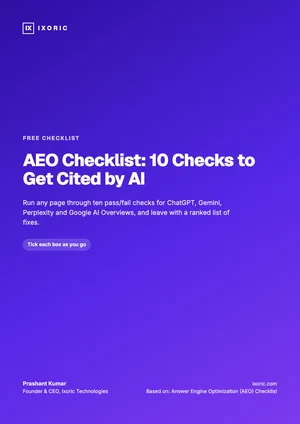
Free checklist · PDF
AEO Checklist: 10 Checks to Get Cited by AI
- Pass/fail tests for ChatGPT, Gemini and AI Overviews
- Priority and time estimate for each check
- A monthly AI citation log
Your checklist is ready.
Download the PDFWas this article helpful?
What was wrong with it?
Take this article to your AI
Get a summary, ask questions, or turn these ideas into a plan for your team.
Opens your AI with the article ready to go — for Gemini, the prompt is copied so you just paste.
Get new articles from Ixoric
Practical SEO, AI search and growth guides, about twice a month. No spam, unsubscribe any time.
You're subscribed
We'll send you new articles as they're published.
Follow us on Google
Add Ixoric as a preferred source to see our articles first in Google results.