
TL;DR
The short version of this article
- HARO link building means answering journalists' source requests so that the resulting article quotes you and links to your site.
- HARO itself was folded into Connectively and shut down in late 2024; the same model now lives on Featured, Qwoted, Help a B2B Writer and SourceBottle.
- Expect roughly 1 placement per 10–20 well-targeted pitches; speed, a specific quotable answer and real credentials decide who gets picked.
In this article
HARO link building is the practice of answering journalists’ requests for expert sources so that the finished article quotes you and links back to your website. It earns editorial links from news and industry publications without paying for placement, which is why it has been a staple white-hat tactic for a decade. This guide covers how the model works in 2026, how to write pitches that get picked, and when it makes sense to run it in-house versus hand it to an agency.
What is HARO, and does it still exist?
HARO (Help A Reporter Out) was a free email service, owned by Cision, that sent journalists’ source requests to subscribers three times a day. In 2024 Cision merged it into a platform called Connectively, and in December 2024 Connectively shut down. So the original HARO no longer exists, but the term “HARO link building” is still used for the whole category of journalist-request platforms.
The same model now runs on several services:
- Featured (formerly Terkel): editors post questions, contributors answer, selected answers are published with a link.
- Qwoted: journalists post requests; free tier with limited pitches, paid tier for more.
- Help a B2B Writer: email digests of requests from B2B content writers, free to sources.
- SourceBottle: strong in Australia and the UK, with a smaller US feed.
- #journorequest on X and LinkedIn: unstructured, but still where many UK journalists ask for sources.
Whichever platform you use, the mechanics are the same: a writer needs a quote, you supply one that is specific and credible, and if they use it you get a mention and, usually, a link.
Why these links are worth the effort
Links earned this way are editorial: a writer chose to include you because your answer was useful. That is exactly the kind of link Google’s spam policies describe as legitimate, and the domains involved (trade publications, news sites, large blogs) tend to have real traffic and authority. For a small or mid-sized site, one quote in a DR 70+ publication can do more for authority than fifty directory listings.
They also carry benefits beyond rankings: brand mentions that AI search engines can pick up when they summarise “who are the experts on X”, referral visits from readers, and quotes you can reuse on your own site as proof of expertise. We treat them as one pillar of the link profile we build in our backlink building service, alongside digital PR and guest contributions.
How HARO-style link building works, step by step
- Sign up as a source on one or more platforms and set the categories that match your real expertise (for us: SEO, digital marketing, small business).
- Read the requests quickly. Deadlines are often 24–48 hours and writers stop reading once they have enough quotes, so the first few hours matter.
- Pick only requests you can answer with first-hand knowledge. A pitch outside your field is ignored and wastes the writer’s time.
- Write a short, quotable answer (see the template below) with your name, role, company and a link to a relevant page.
- Track placements. Set up a Google Alert for your name and company, and check referring domains in Search Console or Ahrefs monthly, because writers rarely tell you when a piece is live.
How to write a pitch that gets quoted
Writers receive dozens of replies per request. The ones they use share the same traits.
- Answer in the first two sentences. Give the actual quote they can paste, not an introduction about yourself.
- Be specific. A number, an example from a real campaign or a clear opinion beats generic advice. A line like “we cut cost per lead by a third by moving budget from Display to Search” is quotable; “focus on data-driven decisions” is not.
- Keep it under 150 words unless the request asks for more.
- Match the format requested. If the writer asks for three tips, send three tips, numbered.
- Give your credentials once, briefly. Name, role, company, one line of proof (years, clients, certification). Link to your bio or a relevant service page, not the homepage.
- Do not attach files or ask for a link. The link is the writer’s call; asking for it reads as spam.
A simple structure that works:
| Part | What to write |
|---|---|
| Subject line | Repeat the request’s own title so it is easy to file |
| Line 1–2 | The direct answer or quote |
| Lines 3–6 | One concrete example or number that supports it |
| Last line | Name, role, company, URL, headshot link if requested |
Realistic numbers: hit rates and time cost
From running this for our own site and for clients, a reasonable expectation is one published placement for every 10–20 well-targeted pitches, with each pitch taking 10–15 minutes to write. That is roughly 3–5 hours of work per link, and the links arrive unevenly: nothing for three weeks, then two in one day. Hit rates improve with a recognisable name and a bio page that shows real credentials, which is one reason we recommend every business keep a proper author or founder page on its site.
Links are usually dofollow from the publication’s own domain, but some outlets nofollow all external links and a few only mention the brand without linking. Both still have value, and unlinked mentions can be converted later with a polite email.
Common mistakes that get pitches ignored
- Pitching outside your expertise because the publication is attractive.
- Sending a company description instead of an answer.
- Using AI-written generic text; writers can tell, and several platforms now ban it.
- Replying after the deadline or after the writer has clearly got enough quotes.
- Following up more than once.
Do it yourself or hire an agency?
If you or someone on your team can spend three to four hours a week on it and has genuine expertise to share, run it in-house: the authenticity of the voice is the asset. Hand it to an agency when you need a predictable number of links per month, when nobody internally has time to watch the feeds, or when you want HARO-style placements combined with digital PR, guest posts and niche edits in a single plan with reporting.
That combined approach is what our link building service delivers: every placement is editorial, verified live, and reported with its domain authority and traffic. The Shivansh Women’s Hospital case study shows what links do as one pillar of a wider SEO campaign, with organic clicks up 737% in four months. If you want to see where your current backlink profile stands, request a free link gap analysis.
HARO link building FAQs
Is HARO link building allowed by Google?
Yes. Google’s spam policies prohibit buying or exchanging links to manipulate rankings. A journalist choosing to quote and link to you is an editorial decision, which is exactly what Google wants links to be.
Is HARO free?
The original HARO was free and no longer exists. Among its replacements, Help a B2B Writer and SourceBottle are free for sources, Featured has free and paid tiers, and Qwoted limits free users to a few pitches a month.
How long does it take to get a link?
Placements typically appear two to eight weeks after a successful pitch, because articles are written and edited after the request closes. Most people see their first published quote within the first month of consistent pitching.
Do I need a PR team or a big brand?
No. Writers want a specific, credible answer from someone with relevant experience. A clear role title and a bio page that shows real work are enough. A recognisable brand helps, but a good quote from a small business owner routinely beats a vague one from a large company.
Are HARO links enough on their own?
Rarely. They build authority and brand mentions, but most sites also need relevant links from their own industry, which usually come from guest contributions, digital PR assets and resource pages. Treat journalist platforms as one channel in a mixed link profile.
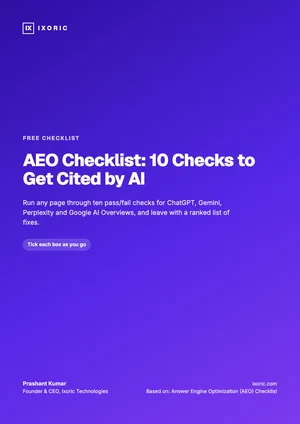
Free checklist · PDF
AEO Checklist: 10 Checks to Get Cited by AI
- Pass/fail tests for ChatGPT, Gemini and AI Overviews
- Priority and time estimate for each check
- A monthly AI citation log
Your checklist is ready.
Download the PDFWas this article helpful?
What was wrong with it?
Take this article to your AI
Get a summary, ask questions, or turn these ideas into a plan for your team.
Opens your AI with the article ready to go — for Gemini, the prompt is copied so you just paste.
Get new articles from Ixoric
Practical SEO, AI search and growth guides, about twice a month. No spam, unsubscribe any time.
You're subscribed
We'll send you new articles as they're published.
Follow us on Google
Add Ixoric as a preferred source to see our articles first in Google results.