TL;DR
The short version of this article
- Google says optimizing for AI Overviews and AI Mode is still SEO: its AI features pull pages from the normal Search index.
- What helps: original, non-commodity content, useful images and video, and the technical basics (crawlable pages, semantic HTML, a good page experience).
- What you don't need: llms.txt files, "chunking" or rewriting pages just for AI, chasing inauthentic mentions, or over-relying on structured data.
In this article
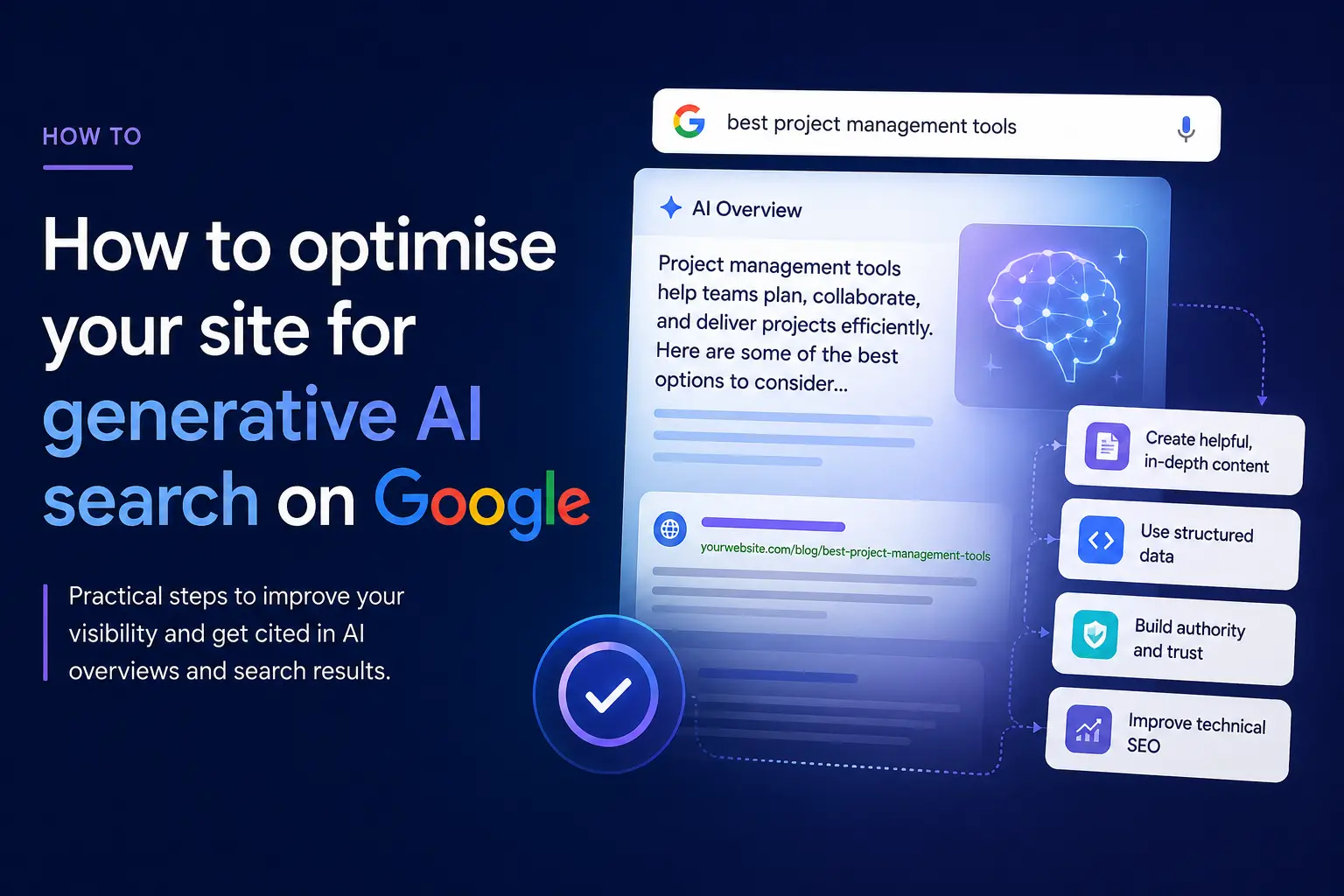
How to optimize your site for generative AI search on Google – People are changing how they search for information. Instead of typing traditional keywords, more users now ask AI directly for answers. Google is evolving Search to match this shift, creating real opportunities for your website.
When your content appears in AI-powered features like AI Overviews and AI Mode, you reach visitors who are ready to engage deeply—whether that means reading more, signing up for updates, or making a purchase. This guide covers Google’s official best practices to help your website perform well in these new AI-driven search experiences.
Is SEO still relevant for generative AI search?
Yes. Google’s AI features enhance search; they do not replace it. These tools pull from the same Search index and ranking systems that have always determined which pages appear at the top. The difference lies in how the information is delivered to users.
How AI features use the Search index
Google’s generative AI features rely on two key techniques:
- Retrieval-augmented generation (RAG) – Also known as grounding, RAG improves the quality, accuracy, and freshness of AI responses by using Google’s core Search ranking systems to retrieve relevant, up-to-date web pages from the Search index. The AI then reviews specific information from those retrieved pages to generate a reliable response, showing prominent, clickable links to the web pages that support the information.
- Query fan-out – The system generates a set of concurrent, related queries to request more information and fetch additional relevant search results. For example, if the original query is “how to fix a lawn that’s full of weeds,” fan-out queries might include “best herbicides for lawns,”“remove weeds without chemicals,” and “how to prevent weeds in lawn.” This means your content can appear even if you did not target the exact original keyword—provided your page thoroughly covers a relevant angle.
What about AEO and GEO?
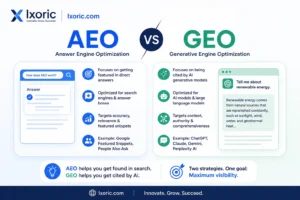
You may see the terms Answer Engine Optimization (AEO) and Generative Engine Optimization (GEO) used online. These describe work specifically focused on improving visibility in AI search experiences.
From Google Search’s perspective, optimizing for generative AI search is optimizing for the search experience itself—and thus, it is still SEO. The principles remain the same: create helpful, accurate, well-structured, and trustworthy content. The goal has always been to match what people are looking for, whether they see a list of blue links or an AI-generated summary.
You do not need to learn an entirely new playbook. Focus on clear answers, genuine expertise, and strong technical foundations, and you will be positioned well for both traditional and AI-powered search.
Apply foundational SEO best practices
Generative AI search is not the end of SEO—it is an evolution. The practices that have always worked continue to matter, and they are key to appearing in AI Overviews and AI Mode.
Create content that only you can provide
Originality is your strongest advantage. AI systems scan countless sources, so content with a distinct perspective stands out. First-hand reviews, original research, and personal expertise carry far more weight than summaries of information already available elsewhere.
Ask yourself what unique experience or insight you bring to the topic. If a generative AI tool could produce the same content in seconds without your input, it will not add value to your site.
Key attributes of valuable content:
- Provides a unique point of view. A first-hand review provides a unique perspective based on personal experience, whereas a summary of existing content simply restates information already available elsewhere. Create content based on what you know, and consider what in-depth experience you can bring.
- Creates non-commodity content. Commodity content (for example, “7 Tips for First-Time Homebuyers”) is often based on common knowledge and adds little unique insight. In contrast, non-commodity content (such as “Why We Waived the Inspection & Saved Money: A Look Inside the Sewer Line”) provides unique expert or experienced takes that go beyond common knowledge.
- Organizes content for your readers. Write for your human audience. Use paragraphs, sections, and headings that provide a clear structure. People appreciate web pages that are easy to navigate.
Use images and video
Many people appreciate finding images and videos as they search. As with Google Search overall, generative AI search features can bring in relevant images and videos, which means more opportunities for your website to appear beyond web page links.
When it makes sense, support your textual content with high-quality, relevant images and videos. If you are already following image SEO best practices and video SEO documentation, you are already optimizing for generative AI search.
Focus on what your users want
While it might be tempting to create separate content for every possible variation of how people might search, doing so primarily to manipulate rankings or generative AI responses violates Google’s scaled content abuse spam policy. This is also an ineffective long-term strategy, as a high quantity of pages does not make a website higher quality or more relevant.
Google’s AI systems have advanced even further and improved upon our ability to understand the relevance of pages, even when there is no exact match between the query and the page’s primary content.
If you are using generative AI tools to assist in content creation, be sure that your work meets the standards of the Search Essentials and our spam policies. For more details, see our guidance on AI-generated content.
One question to guide every decision
You can simplify your approach by focusing on one core principle: focus on what your visitors would enjoy, find helpful, and feel satisfied with after visiting your website.
If you are ever unsure about a decision for your site, ask yourself: “Is this content that my visitors would find satisfying?” If the answer is yes, then you are on the right track. Our systems are designed to connect people with exactly that kind of useful information.
For more, check out our guide to creating helpful, reliable, people-first content.
Build and maintain a clear technical structure
The way Google Search finds and processes your pages remains the core of how our AI systems access your data. Technical clarity ensures your content is ready for discovery and indexing, and all existing technical SEO best practices continue to be worthwhile.
Meet the Search technical requirements
To be eligible to be shown in generative AI features on Google Search, a page must be:
- Indexed — Google must be able to crawl and store your page in its index.
- Snippet-eligible — Your page must qualify to be shown in Google Search with a snippet, fulfilling the Search technical requirements.
If your page fails these basic technical checks, it will not surface in AI Overviews or similar features, regardless of how strong your content is.
Important: Just because a page meets every criterion, best practice, and policy does not mean that Google will index or serve its content. There is no guarantee of indexing or serving.
Follow crawling best practices
To maximize your site’s visibility in generative AI search features, ensure your content is crawlable. Google Search generative AI models use publicly accessible, crawlable content to learn patterns and provide relevant, grounded responses.
For very large and frequently updated sites, review our guide to optimizing your crawl budget.
Use semantic HTML for people
While it is not required to have perfectly semantic HTML (the web in general is not valid HTML, and Google can understand it), it is generally a good idea to try to use semantic HTML when possible. It helps other types of users, such as screen readers, to parse and navigate your web page more easily.
Focus on human readability rather than perfect code.
Follow JavaScript SEO best practices
If you are using JavaScript, be sure to follow JavaScript SEO best practices. Google is able to process content within JavaScript as long as it is not blocked.
That said, working on SEO with a website that uses JavaScript frameworks is generally more complex than when working with other kinds of websites. Make sure to follow the usual SEO best practices for JavaScript.
Provide a good page experience
Ensure your site displays well across all devices, reduces latency, and makes it easy for people to distinguish your main content from other elements on the page. A good page experience keeps users engaged and signals quality to search systems.
Reduce duplicate content
Having duplicate content can be a bad user experience, and search engines might waste crawling resources on URLs that you do not even care about. If you have time, try to reduce it. Consolidate duplicate pages with canonical tags or redirects so Google concentrates its effort on the pages you want to rank.
Monitor with Search Console
To discover and diagnose potential technical issues quickly, verify your site in Search Console. For more, check out our technical guide to SEO and our documentation on maintaining your website’s SEO.
Optimize your local business and e-commerce details
Where appropriate, generative AI responses can include product listings, product information, and information about local businesses.
Using products like Merchant Centre (such as Merchant Centre feeds) and Google Business Profiles can help your products and services to be visible in both AI responses and other Google Search results.
Learn more about how to add and manage your business details on Google Search.
Mythbusting generative AI search: what you don’t need to do
As generative AI search evolves, so have the theories and practices surrounding it. While terms like AEO or GEO are common online, many suggested “hacks” are not effective or supported by how Google Search actually works.
To help you focus on what matters, here are a few things you can ignore for Google Search:
LLMs.txt files and other “special” markup
You do not need to create new machine-readable files, AI text files, markup, or Markdown to appear in generative AI search. Google may discover, crawl, and index many kinds of files in addition to HTML on a website—this does not mean that the file is treated specially.
“Chunking” content
There is no requirement to break your content into tiny pieces for AI to better understand it. Google systems are able to understand the nuance of multiple topics on a page and show the relevant piece to users.
However, sometimes shorter (or longer) pages can work well depending on your audience and subject matter. There is no ideal page length. In the end, make pages for your audience, not just for generative AI search.
Rewriting content just for AI systems
You do not need to write in a specific way just for generative AI search. AI systems can understand synonyms and general meanings of what someone is seeking, in order to connect them with content that might not use the same precise words.
This means you do not have to worry that you do not have enough “long-tail” keywords or have not captured every variation of how someone might seek content like yours.
Seeking inauthentic “mentions.”
Just like the rest of Google Search, our generative AI features can show what is being said about products and services across the web, including in blogs, videos, and forum discussions. However, seeking inauthentic “mentions” across the web is not as helpful as it might seem.
Our core ranking systems focus on high-quality content, while other systems block spam; our generative AI features depend on both.
Overfocusing on structured data for AI
Structured data is not required for generative AI search, and there is no special schema.org markup you need to add. However, it is a good idea to continue using it as part of your overall SEO strategy, as it helps with being eligible for rich results on Google Search.
Explore agentic experiences
AI agents are autonomous systems that can perform tasks on behalf of people, such as booking a reservation or comparing product specifications. These agents can take many forms; for example, browser agents may access your website to gather the data they need to complete these tasks, such as analyzing visual renderings (like screenshots), inspecting the DOM structure, and interpreting the accessibility tree.
If this is something that is relevant to your business and you have extra time, check out the available agentic experiences and review the guide to agent-friendly website best practices, which gives some insights into how a website can generally prepare for current browser agents.
Protocols like Universal Commerce Protocol (UCP) are emerging that will allow Search agents to do more.
How to optimize your site for generative AI search on Google – Next steps: what to focus on
As you continue working on your website, remember that plenty of content thrives in Google Search (including generative AI experiences) without any overt SEO at all. You do not need to accomplish everything in this guide to succeed on Google Search. if you are looking for a company to optimize your website for AI search results, so you can connect with the Ixoric Team.
To recap, here are the key takeaways:
- Apply SEO best practices to generative AI search. Continue prioritizing foundational SEO best practices, such as building a clear technical structure and creating unique, valuable content; these are the foundation for visibility in generative AI search experiences (and Google Search overall).
- Create non-commodity content that is helpful, reliable, and people-first. Focus on developing unique, expert-led content that provides value beyond common knowledge.
- Prioritize effective SEO strategies over “AEO/GEO hacks.” For Google Search, you can ignore tactics like “chunking” content, creating unnecessary AI text files (like llms.txt), or pursuing inauthentic mentions.
- Explore agentic experiences. Stay informed about emerging technologies that allow AI agents to interact with your site, such as browser agents and new protocols.
Free checklist · PDF
AEO Checklist: 10 Checks to Get Cited by AI
- Pass/fail tests for ChatGPT, Gemini and AI Overviews
- Priority and time estimate for each check
- A monthly AI citation log
Your checklist is ready.
Download the PDFWas this article helpful?
What was wrong with it?
Take this article to your AI
Get a summary, ask questions, or turn these ideas into a plan for your team.
Opens your AI with the article ready to go — for Gemini, the prompt is copied so you just paste.
Get new posts on WhatsApp
We'll message you when a new article is out. Reply STOP any time.
Subscribe on WhatsApp
Follow us on Google
Add Ixoric as a preferred source to see our articles first in Google results.